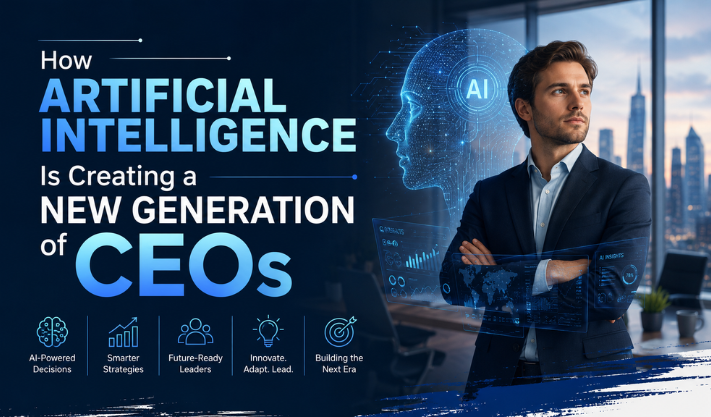
Artificial intelligence is no longer simply a technology used by IT teams. It is becoming a strategic force that is changing how companies are built, managed, and scaled. From automating repetitive work to helping leaders make faster decisions, AI is creating a new generation of CEOs who combine business judgment with technological fluency.
What Does AI Have to Do With the Next Generation of CEOs?
AI is changing what effective leadership looks like. Traditional CEOs often focused heavily on people management, financial performance, operations, and long-term strategy. Today, leaders must also understand how AI can improve productivity, customer experiences, decision-making, and innovation.
The next generation of CEOs does not necessarily need to become an AI engineer. Instead, they need to understand what AI can do, where it creates value, and how to use it responsibly.
How Is Artificial Intelligence Changing the Role of a CEO?
AI is helping CEOs move from managing information to interpreting it more effectively.
Modern AI systems can analyze large volumes of data, identify patterns, summarize complex information, and support forecasting. This allows executives to spend less time collecting information and more time making strategic decisions.
For example, an AI-powered system can help identify changes in customer behavior, highlight operational inefficiencies, or provide insights into market trends. The CEO still makes the final decision, but AI can make the decision-making process faster and more informed.
Why Are AI-Literate CEOs Becoming More Important?
AI literacy is becoming a competitive advantage.
An AI-literate CEO understands basic concepts such as automation, machine learning, generative AI, data analysis, and AI governance. More importantly, they understand how these technologies connect to business objectives.
This knowledge helps leaders ask better questions:
- Where can AI reduce unnecessary costs?
- Which business processes can be automated?
- How can AI improve customer service?
- What new products could AI make possible?
- How should AI be used responsibly?
CEOs who can answer these questions are better positioned to lead organizations through technological change.
Can AI Create Better Business Decision-Makers?
AI can significantly support decision-making, but it does not replace leadership judgment.
Executives can use AI to compare scenarios, analyze historical data, identify risks, and generate strategic possibilities. This can provide leaders with a broader view before they make important decisions.
However, AI-generated recommendations still need human evaluation. Business decisions often involve ethics, relationships, company culture, uncertainty, and human consequences—areas where leadership experience remains essential.
The strongest CEOs will therefore combine AI intelligence with human intelligence.
How Is AI Helping New CEOs Build Companies Faster?
AI is lowering some of the barriers to starting and scaling businesses.
A small leadership team can now use AI tools for tasks such as market research, content creation, customer support, data analysis, software development, documentation, and workflow automation.
This means entrepreneurs can potentially accomplish work that previously required larger teams or specialized departments.
AI does not eliminate the need for employees. Instead, it can allow smaller teams to operate more efficiently while giving people more time to focus on creativity, relationships, strategy, and complex problem-solving.
What Skills Will Future CEOs Need in an AI-Driven Economy?
Future CEOs will need a combination of traditional leadership abilities and technology-focused skills.
Important capabilities include:
- Strategic thinking — understanding how technology supports long-term business goals.
- AI literacy — knowing the capabilities and limitations of artificial intelligence.
- Data-driven decision-making — using information effectively without becoming dependent on algorithms.
- Adaptability — responding quickly as technology and markets evolve.
- People leadership — helping employees adapt to changing roles and workflows.
- Ethical judgment — ensuring AI is used responsibly and transparently.
- Continuous learning — staying informed about emerging technologies.
The future CEO is likely to be less defined by a single area of expertise and more by the ability to connect technology, people, and strategy.
Will AI Replace CEOs?
No. AI is more likely to change the responsibilities of CEOs than eliminate them.
A CEO is responsible for setting a company’s vision, building organizational culture, managing stakeholders, making difficult trade-offs, and taking responsibility for major decisions. These responsibilities require judgment and accountability.
AI can provide recommendations, but it does not carry the same organizational responsibility as a human leader.
The future is therefore more likely to involve AI-augmented CEOs rather than AI-replaced CEOs.
How Is AI Changing Leadership and Company Culture?
AI is also influencing how organizations work internally.
CEOs are increasingly expected to create environments where employees can experiment with new technologies while maintaining appropriate safeguards. This requires clear policies, training, communication, and a willingness to learn from mistakes.
A successful AI-driven culture is not simply about buying AI tools. It is about teaching employees how to use technology effectively and ensuring that innovation remains aligned with the company’s goals and values.
Why Is Human Creativity Still Important?
AI can generate ideas, analyze information, and produce content, but human creativity remains central to leadership.
Great CEOs need to understand customers, recognize opportunities, inspire teams, develop a compelling vision, and make decisions when there is no perfect answer.
AI can accelerate the creative process, but humans provide context, purpose, and direction.
The most successful leaders will likely treat AI as a collaborator rather than a substitute for human thinking.
What Does the Future CEO Look Like?
The future CEO may be more technologically informed, data-driven, adaptable, and comfortable with experimentation.
Instead of asking whether AI should be used, future leaders will increasingly ask where it should be used, how it should be governed, and what value it can create.
This shift could produce organizations that are faster, leaner, and more innovative. At the same time, CEOs will need to manage challenges involving privacy, cybersecurity, misinformation, workforce disruption, and responsible AI adoption.
How Can Aspiring CEOs Prepare for an AI-Driven Future?
Aspiring leaders can begin by learning the fundamentals of AI and experimenting with practical applications. They should understand how AI affects their industry, identify repetitive business processes, and learn how to evaluate AI-generated information critically.
They should also strengthen skills that technology cannot easily replicate: communication, emotional intelligence, strategic thinking, negotiation, creativity, and ethical leadership.
The goal is not to become a technology expert overnight. The goal is to become a leader who understands how technology can create meaningful business value.
What Is the Biggest Leadership Lesson From the Rise of AI?
The biggest lesson is that technology alone does not create successful companies. Leadership determines how technology is used.
AI gives CEOs powerful new capabilities, but those capabilities require direction. Leaders must decide what problems are worth solving, which risks are acceptable, and how innovation should benefit customers, employees, and the wider organization.
The next generation of CEOs will therefore be defined not simply by their ability to use artificial intelligence, but by their ability to combine AI with vision, responsibility, creativity, and human leadership.
Final Answer: Is AI Creating a New Generation of CEOs?
Yes. Artificial intelligence is helping create a new generation of CEOs who are more comfortable with technology, automation, data, and rapid experimentation.
These leaders are not replacing traditional leadership principles. They are expanding them.
The CEO of the future will likely be someone who can understand technology without losing sight of people, use data without ignoring intuition, and embrace automation without sacrificing creativity.
Also Read:-
The CEO Influencer Era: Leadership as a Personal Brand
Inside Boardrooms Where AI Is Reshaping Business Decisions
Second-Time Founders Who Built Billion-Dollar Businesses