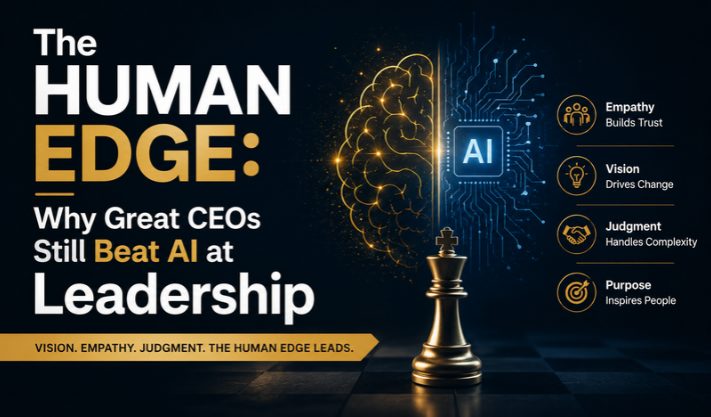
Why Leadership Requires More Than Data
AI is highly effective at processing information, identifying trends, developing strategies, and supporting decisions. However, leadership requires more than information processing. It requires human judgment, emotional intelligence, trust, courage, empathy, and the ability to inspire others.
Why Human Context Matters
A CEO must understand people, organizational culture, market uncertainty, customer expectations, employee concerns, and often unspoken emotions. Decisions are rarely made with perfect information.
A technically correct decision may still be inappropriate for a particular organization or culture. AI can recommend an action, but a CEO must understand its human consequences.
Why Does Emotional Intelligence Still Matter for CEOs?
How CEOs Understand People
One of the greatest advantages human leaders have over AI is emotional intelligence. Great CEOs understand how people feel, communicate difficult messages with sensitivity, resolve conflicts, and create environments where employees feel valued and motivated.
Can AI Read Human Emotions?
AI can analyze employee feedback and identify patterns in workplace sentiment. However, it does not experience human relationships in the same way people do.
During a challenging meeting, a CEO can recognize hesitation, impatience, confidence, or uncertainty through tone, body language, and personal interaction. These subtle signals can influence leadership decisions in ways machines cannot fully replicate.
Could AI Be Better Than CEOs at Making Business Decisions?
Why Faster Decisions Are Not Always Better
AI can make data-driven decisions quickly, but speed does not always equal quality. Businesses often have to make important decisions with incomplete information.
A CEO may need to decide whether to enter a new market, invest during a downturn, retain an underperforming employee, or pursue an unconventional opportunity.
Where Human Judgment Makes a Difference
The answer may not always exist in historical data. Human leaders bring intuition, experience, creativity, and contextual judgment. They can also ask questions that are difficult to encode into an algorithm.
The strongest approach is therefore not AI versus CEO, but AI working with the CEO.
AI provides the evidence. The CEO makes the call.
Why Does Human Trust Matter in Leadership?
How CEOs Build Organizational Trust
People do not simply follow strategies; they follow leaders they trust. Trust develops through consistency, transparency, accountability, and personal connection.
Employees want leaders who accept responsibility when things go wrong and share credit when things go right.
Why Authenticity Matters During a Crisis
During difficult periods, a CEO who communicates honestly can earn organizational loyalty even when the news is challenging.
AI can generate a polished corporate statement, but employees often respond to the authenticity and accountability behind the message.
Leadership is ultimately a relationship, and meaningful relationships are built by people.
Can AI Motivate Employees?
Why Inspiration Is Different From Automation
AI can support employee engagement through personalized recommendations, performance insights, and automated communication. However, inspiration is not the same as motivation.
How Great CEOs Create Purpose
Great CEOs build a vision that makes people feel they are part of something meaningful.
Being told what to do is fundamentally different from being inspired to create something capable of transforming an industry. The latter requires storytelling, conviction, ambition, and emotional connection.
Human CEOs can explain why a company exists, what it represents, and where it wants to go. A strong sense of purpose can transform employees from task-doers into committed contributors.
Why Should Today’s CEOs Value Creativity?
Can AI Replace Human Creativity?
AI can generate ideas quickly, but human creativity remains essential because breakthrough thinking often comes from unexpected connections.
A CEO may recognize an opportunity through personal experience, a conversation, a cultural observation, or an apparently unrelated trend.
What Questions Should Great CEOs Ask?
Great leadership often begins with questions such as:
- What if the industry were completely transformed?
- What are customers not telling us?
- What challenge are competitors failing to see?
- What opportunity could emerge five years from now?
AI can help investigate these questions, but human leaders must decide which ideas deserve belief, investment, and action.
How Does Courage Give CEOs a Human Advantage?
Why Leadership Requires Risk
Leadership means making difficult decisions when outcomes are uncertain.
A CEO may need to invest millions in unproven technology, enter an unfamiliar market, challenge conventional wisdom, or maintain a long-term vision while others remain skeptical.
Can AI Demonstrate Courage?
AI can calculate probabilities and identify risks, but it cannot personally experience courage or carry the emotional responsibility of a critical leadership decision.
In an AI-driven economy where calculated risks matter, courageous CEOs can become an increasingly valuable asset.
What Happens When AI and Human Leadership Come Together?
How AI Can Support CEOs
The CEOs of the future will be those who effectively combine technological intelligence with human intelligence.
AI can help leaders:
- Analyze enormous volumes of business data
- Identify emerging market trends
- Automate routine processes
- Improve forecasting
- Personalize customer experiences
- Detect operational inefficiencies
- Support strategic planning
What Should CEOs Continue to Own?
Human leaders can focus more deeply on:
- Organizational culture
- Skills development
- Vision creation
- Relationship management
- Ethical decision-making
- Team inspiration
- Managing uncertainty
- Owning results
This creates a powerful leadership model: AI handles more complexity, while humans remain responsible for meaning, direction, and accountability.
Will AI Take the CEO’s Role in the Future?
How the CEO Role Is Changing
AI may significantly influence what CEOs do, but it is much less likely to completely replace great human leadership.
The CEO role is shifting from being a gatekeeper of information to becoming a strategic orchestrator.
What Will the Future CEO Look Like?
Future CEOs will need to be both emotionally intelligent and technologically literate. They will need to understand artificial intelligence systems while also understanding people.
The most successful leaders will not compete against AI. They will learn how to use it more effectively than their competitors.
The real advantage will come from combining human judgment with machine intelligence.
What Is the Greatest Human Advantage in Leadership?
Why Values Still Matter
One of humanity’s greatest leadership advantages is the ability to connect decisions with values and ideals.
Businesses do not operate in isolation. They are communities of employees, customers, investors, partners, and other stakeholders.
Every major business decision affects people.
How Should Business Success Be Measured?
A strong CEO understands that success is about more than efficiency and revenue. It can also be measured through trust, reputation, innovation, employee commitment, customer loyalty, and long-term impact.
AI can help measure many of these factors, but human leaders must determine what those measurements ultimately mean.
How Can CEOs Stay Relevant in an Era of AI?
What Skills Should CEOs Develop?
CEOs should focus on developing skills that artificial intelligence cannot easily replicate while becoming highly capable users of technology.
They should understand how AI works, where it can create value, and how it can improve decision-making without giving up human responsibility.
Which Human Skills Will Become More Important?
CEOs should continue strengthening:
- Communication
- Empathy
- Critical thinking
- Innovation
- Adaptability
- Relationship building
- Ethical judgment
- Strategic vision
The future belongs neither exclusively to humans nor exclusively to machines.
It belongs to leaders who know how to make both work together.
Final Answer: Why Do Great CEOs Still Beat AI in Leadership?
Why Leadership Is Still Human
Leadership is ultimately human, and great CEOs still have the edge.
AI can calculate, forecast, automate, and recommend. A great CEO listens, learns, motivates, takes ownership, builds trust, and makes bold decisions during uncertain times.
What Will Define Great Leadership in the AI Era?
The most important leadership ability of the future will not be fighting AI. It will be recognizing when to rely on AI and when human judgment needs to remain at the center.
Artificial intelligence will continue to become more powerful. Yet human qualities that once seemed ordinary—empathy, courage, vision, authenticity, and trust—may become the most valuable leadership advantages of all.
Also Read:-
How AI Is Creating a New Generation of CEOs
The CEO Influencer Era: Leadership as a Personal Brand
Inside Boardrooms Where AI Is Reshaping Business Decisions