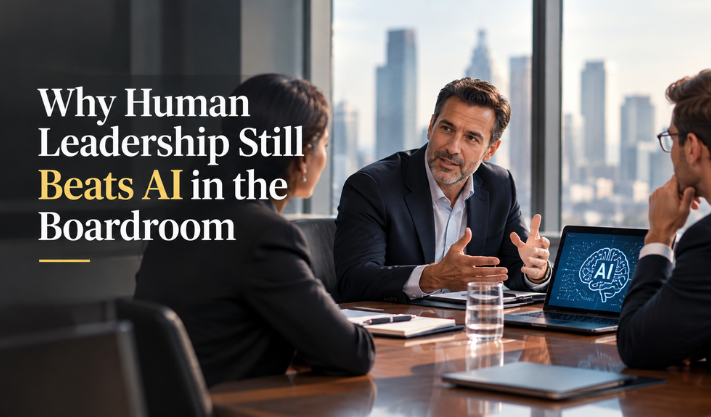
Artificial Intelligence and Executive Leadership
Artificial intelligence is transforming how corporations compete, innovate, and decide. As AI becomes embedded in day-to-day business, CEO leadership is evolving too. Leaders are no longer supposed to merely manage people, finances and long-term strategies. They’ll also need to comprehend AI, lead responsible adoption, build flexible teams and make judgments in a constantly changing tech environment.
The new norms of executive leadership in the AI age center on a mix of strategic thinking, technology awareness, human judgment, adaptability, and responsible innovation.
Executive Leadership in an Era of AI – What Does It Mean?
Being an executive in the modern era of AI is about how to lead an organization with a clear grasp of how artificial intelligence might impact the organization’s strategy, operations, employees, customers, and competitive advantage.
Modern executives don’t need to be AI engineers. But they need to be AI literate enough to understand what the technology can and cannot do, where it adds value and what risks it brings.
Strategic Use of AI
Great leaders don’t just jump on the technology bandwagon; they map the capabilities of AI to the business objectives.
Why Is AI Transforming Executive Leadership?
AI is speeding up commercial decision making. Organizations can evaluate huge volumes of data, automate routine procedures, customize consumer experiences and support employees with smart tools.
That requires faster decision-making by CEOs in the face of growing technological complexity.
The traditional leader frequently concentrated on predictable planning and incremental change. AI organizations need to be led by people who can experiment, learn fast, change tack and respond to market shifts.
What Is the Most Important Leadership Skill in the AI Era?
The ability to adapt is one of the most crucial qualities.
Artificial intelligence is moving fast so executives cannot rely on techniques that worked in the past. They must build companies that are learning all the time.
Flexible executives enable innovation while keeping a clear corporate agenda.
Questions Leaders Should Ask
What problem are we solving?
Can AI make the process better?
What could possibly go wrong?
What does success look like?
This helps to make AI adoption outcome-focused and not just technology-focused.
Do CEOs Need to Be AI Experts?
No. CEOs don’t have to be programmers or experts in machine learning.
But they do require practical AI literacy. Executives need to comprehend concepts like generative AI, automation, data quality, AI governance, cybersecurity, model constraints and algorithmic bias.
This is not a technical mastery. The goal is educated leadership.
A CEO who knows the basics of artificial intelligence is able to ask better questions, analyze investments better and communicate in a more meaningful way with both technical and non-technical staff.
How Should Executives Harness AI for Decision Making?
Artificial intelligence can help executives make decisions by spotting patterns, interpreting data, creating scenarios, and condensing complex data.
But typically, it is best to think of AI as a tool that helps with decisions, not as an unquestionable authority.
Executives still need human judgment to assess context, ethics, business priorities and consequences. Good leadership models integrate machine-aided analysis with human responsibility.
AI as a Decision-Support Tool
The greatest question is not “What does AI recommend?” but “What can AI help us understand and what decision should humans ultimately make?”
What’s the New Function of Human Judgment?
As AI improves, human judgment becomes increasingly important.
AI is able to process information fast, but leadership is about ambiguity, values, relationships, empathy and accountability. Executives must think about how technology impacts employees, consumers, partners, and society.
Within this framework, it is crucial for leaders to cultivate traits that robots cannot simply replicate, including empathy, critical thinking, creativity, communication, and ethical reasoning.
The future of leadership isn’t human vs. AI. It’s leaders learning to blend human skills with machine capabilities.
How Can Leaders Get Staff Ready for AI?
Executives should view AI adoption as a workforce transformation, not just a technological initiative.
Employees need opportunities to gain AI literacy and to understand how the new technologies might be integrated into their current roles. Leaders will need to be clear about why AI is being implemented and how it could alter workflows.
Training should incorporate both technical skills and practical judgment. Employees need to be able to check AI-generated material, secure confidential data, find flaws and utilize AI responsibly.
Building an AI-Ready Workforce
Organizations that invest in people as well as technology are more likely to build sustainable AI adoption.
Why Does AI Governance Matter for Executives?
AI governance supports organizations in defining the ground rules for ethical and safe AI use.
Executives must understand privacy, cybersecurity, intellectual property, transparency, bias, accuracy, regulatory demands and responsibility.
A clear governance framework may make it obvious which AI applications are permissible, what information can be input into artificial intelligence systems, who reviews significant outputs, and how possible risks are escalated.
Responsible AI Leadership
Responsible leadership is not something artificial intelligence is able to do, but what it should do.
How Should Leaders Embrace AI Innovation?
Executives have to create an environment that fosters experimentation, while retaining control.
Instead of trying to change the entire organization overnight, executives may select high-value use cases, run controlled pilots, measure results and expand successful initiatives.
Measuring AI Success
Useful metrics can include productivity increases, cost savings, customer happiness, sales growth, employee experience and risk reduction.
This establishes a workable innovation cycle – test, measure, learn, improve, scale.
What Leadership Error Should Leaders Not Make?
The worst mistake is to go on AI without a defined commercial purpose.
Don’t buy tools or start AI projects just because everyone else is. This might lead to unneeded costs and confusion.
Another fallacy is to think that AI-generated information is automatically correct. Artificial intelligence systems can generate wrong, incomplete or misleading outputs.
Executives should therefore set clear goals, verification mechanisms and accountability before deploying AI for critical business operations.
The Changing Nature of Executive Communication
Leaders in the AI age need to speak more regularly and more openly.
Employees may be concerned about changes to their workplace, automation, performance demands and the future of their career. Silence can breed doubt.
Executives need to tell their people what is changing, why it is changing and how the staff will be supported.
Listening to Employees
Communication is also about listening. Leaders should seek feedback from the people on the front lines who work with AI technologies every day, since they tend to recognize real difficulties that executives can’t perceive from the strategic level.
What Does Good AI Leadership Look Like?
Successful AI leadership is the art of combining vision and discipline.
A strong executive sets a clear strategic direction, fosters AI literacy, invests in people, builds responsible governance, promotes innovation and measures results.
There’s no need for the leader to supervise every AI project directly. Instead, the executive sets the stage for teams to optimally use technology in a responsible manner.
Ultimately, the key to success is tying AI to the real demands of an enterprise.
What Are the New Rules for Executive Leadership in the AI Era?
Key Principles for AI-Era Leadership
Learn AI without requiring an engineer.
Tie each AI initiative to a measurable business purpose.
Put human judgment at the heart of key decisions.
Build AI fluency across your team.
Prioritize responsible AI governance at the top level.
Encourage risk-taking and experimentation.
Be honest about technological change.
Focus on measuring outcomes, not simply AI adoption.
Be adaptive as technology changes.
Leverage AI to empower human skills, not just substitute them.
What Is the Future of Executive Leadership?
The future of executive leadership will be increasingly about managing people and sophisticated technologies.
Artificial intelligence is able to automate numerous jobs, but it does not replace the necessity for leadership. It lifts the bar instead. Executives need to be better strategists, communicators, educators and decision makers.
Also Read:-
Why Every CEO Needs an AI Strategy for Business Success
Tech Innovations Redefining Modern Entrepreneurship Today
Bootstrapped Startups Are Outpacing VC-Backed Rivals