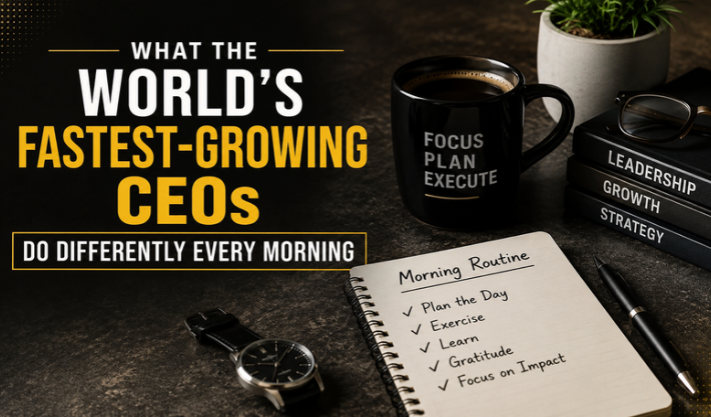
The morning routines of successful CEOs often reveal more than their schedules. While there is no single formula for becoming a high-growth business leader, many of the world’s fastest-growing CEOs share a similar approach: they protect their attention, prioritize important decisions, stay informed, and create time for strategic thinking.
For founders and executives, the goal is not simply to wake up earlier. It is to start the day intentionally rather than reactively.
Below are some of the most common morning habits that can help CEOs improve focus, leadership, productivity, and decision-making.
What do successful CEOs do first thing in the morning?
Successful CEOs often begin their mornings by creating a period of uninterrupted time.
Instead of immediately responding to emails, notifications, or social media messages, they may spend their first hours reviewing priorities, thinking strategically, exercising, reading, or preparing for important meetings.
The key difference is intentionality.
A reactive morning allows other people’s priorities to control the day. A strategic morning allows leaders to decide what deserves their attention.
Why do CEOs avoid checking emails immediately?
Email can create a false sense of productivity.
When executives open their inbox immediately after waking up, they can quickly become focused on other people’s requests rather than their own priorities. A single email can turn into a chain of meetings, calls, and decisions.
Many productive leaders therefore create a buffer before entering communication mode.
This does not mean ignoring important messages. Instead, it means identifying the day’s most important objective before allowing incoming information to dictate the schedule.
Do fast-growing CEOs exercise in the morning?
Exercise is another common part of executive morning routines.
A morning workout can help establish discipline and create a clear transition between personal time and professional responsibilities. Some CEOs prefer running or cycling, while others choose strength training, walking, yoga, or short mobility sessions.
The specific exercise matters less than consistency.
For busy leaders, even a 20- to 30-minute workout can become a practical way to start the day with energy and mental clarity.
How do CEOs plan their day?
High-performing CEOs generally focus on priorities rather than simply creating long to-do lists.
Instead of asking, “What can I accomplish today?” they may ask:
- What is the most important business problem I need to solve?
- Which decision cannot wait?
- What will create the greatest impact?
- What does my team need from me today?
- Which task should I delegate?
This approach helps executives distinguish between activity and meaningful progress.
A calendar filled with meetings does not necessarily indicate a productive day. Strategic leaders understand that their most valuable contribution may be making one important decision or solving one critical problem.
Why is strategic thinking important in the morning?
CEOs are responsible for looking beyond today’s problems.
Morning quiet time can provide an opportunity to think about larger questions such as market trends, customer behavior, competitors, company culture, technology, and long-term growth.
This is especially important for rapidly growing companies.
As organizations expand, CEOs can easily become trapped in operational details. Strategic thinking helps them step back and consider where the business should go next.
Do successful CEOs read every morning?
Many business leaders make time for reading or learning.
This can include business news, industry reports, books, research papers, customer feedback, market analysis, or information about emerging technologies.
The purpose is not simply to consume more information. It is to develop better judgment.
A CEO who understands changes in technology, consumer expectations, economic conditions, and industry trends can make more informed decisions.
However, effective leaders also recognize the danger of information overload. The goal is to consume information selectively rather than endlessly scrolling through news feeds.
How do CEOs protect their focus?
One of the biggest differences between highly effective executives and constantly busy executives is their approach to attention.
Fast-growing CEOs often protect blocks of time for high-value work.
During these periods, unnecessary notifications may be turned off and meetings minimized.
This creates space for activities that require concentration, including:
- Strategic planning
- Product development
- Financial analysis
- Hiring decisions
- Business development
- Creative thinking
- Problem-solving
Deep work is particularly valuable because important decisions rarely benefit from constant interruption.
Do CEOs spend time with their teams in the morning?
Yes, communication is an important part of executive leadership.
Some CEOs use morning meetings or short check-ins to understand what is happening across the organization. However, effective leadership is not about attending every meeting.
Instead, successful CEOs often focus on removing obstacles and giving their teams clarity.
A short conversation that answers “What is blocking you?” can sometimes be more valuable than a lengthy status meeting.
How do CEOs decide what not to do?
This is one of the most important habits of high-growth leadership.
As a company becomes larger, opportunities multiply. New partnerships, meetings, projects, technologies, and ideas compete for attention.
A CEO cannot personally pursue everything.
Successful leaders therefore learn to say no.
They delegate tasks that others can handle, eliminate unnecessary meetings, and avoid projects that do not align with the company’s strategy.
The ability to protect attention can become a significant competitive advantage.
What role does mindfulness play in a CEO’s morning?
Some executives use meditation, breathing exercises, journaling, or quiet reflection to prepare mentally for the day.
Leadership involves uncertainty, pressure, and frequent decision-making. A few minutes of reflection can help create emotional distance before responding to difficult situations.
Journaling can also help leaders clarify their thoughts.
Simple questions such as “What matters most today?” or “What decision am I avoiding?” can encourage more deliberate thinking.
Do successful CEOs follow the same morning routine every day?
Not necessarily.
There is no universal CEO morning routine.
Some leaders wake up extremely early, while others start later. Some exercise before breakfast, while others prefer reading or spending time with family.
The important principle is consistency around priorities, not copying another executive’s exact schedule.
A morning routine should match an individual’s responsibilities, personality, energy levels, and lifestyle.
What is the biggest lesson from successful CEO morning routines?
The biggest lesson is that successful CEOs do not necessarily try to make their mornings more complicated.
They make them more intentional.
Instead of immediately reacting to messages, meetings, and external demands, they create time to decide what deserves attention.
A productive morning may therefore look surprisingly simple:
Wake up → recharge → review priorities → think strategically → focus on important work → communicate with the team.
The exact routine can change, but the underlying philosophy remains the same.
How can entrepreneurs create a CEO-style morning routine?
Entrepreneurs do not need an expensive lifestyle or a 5 a.m. wake-up schedule to build an effective routine.
Start with three simple habits.
First, protect the first 30 minutes. Avoid unnecessary notifications and decide what matters most.
Second, identify one high-impact priority. Choose the task that could make the biggest difference to the business.
Third, create time for your physical and mental health. Exercise, walking, meditation, reading, or quiet reflection can help establish a sustainable rhythm.
Over time, these small habits can become a powerful foundation for better leadership.
Final Thoughts: Why Morning Habits Matter for CEOs
The world’s fastest-growing CEOs are not successful simply because they wake up early. Their advantage often comes from how deliberately they use their attention.
They prioritize important decisions, protect time for strategic thinking, maintain their energy, stay informed, communicate clearly, and avoid unnecessary distractions.
For aspiring entrepreneurs and business leaders, the lesson is straightforward: don’t focus on creating the perfect morning routine. Build a morning routine that consistently prepares you to make better decisions.
Also Read:-
Invisible CEOs: Why Quiet Leaders Let Results Speak
The Human Edge: Why CEOs Still Outlead AI
How AI Is Creating a New Generation of CEOs