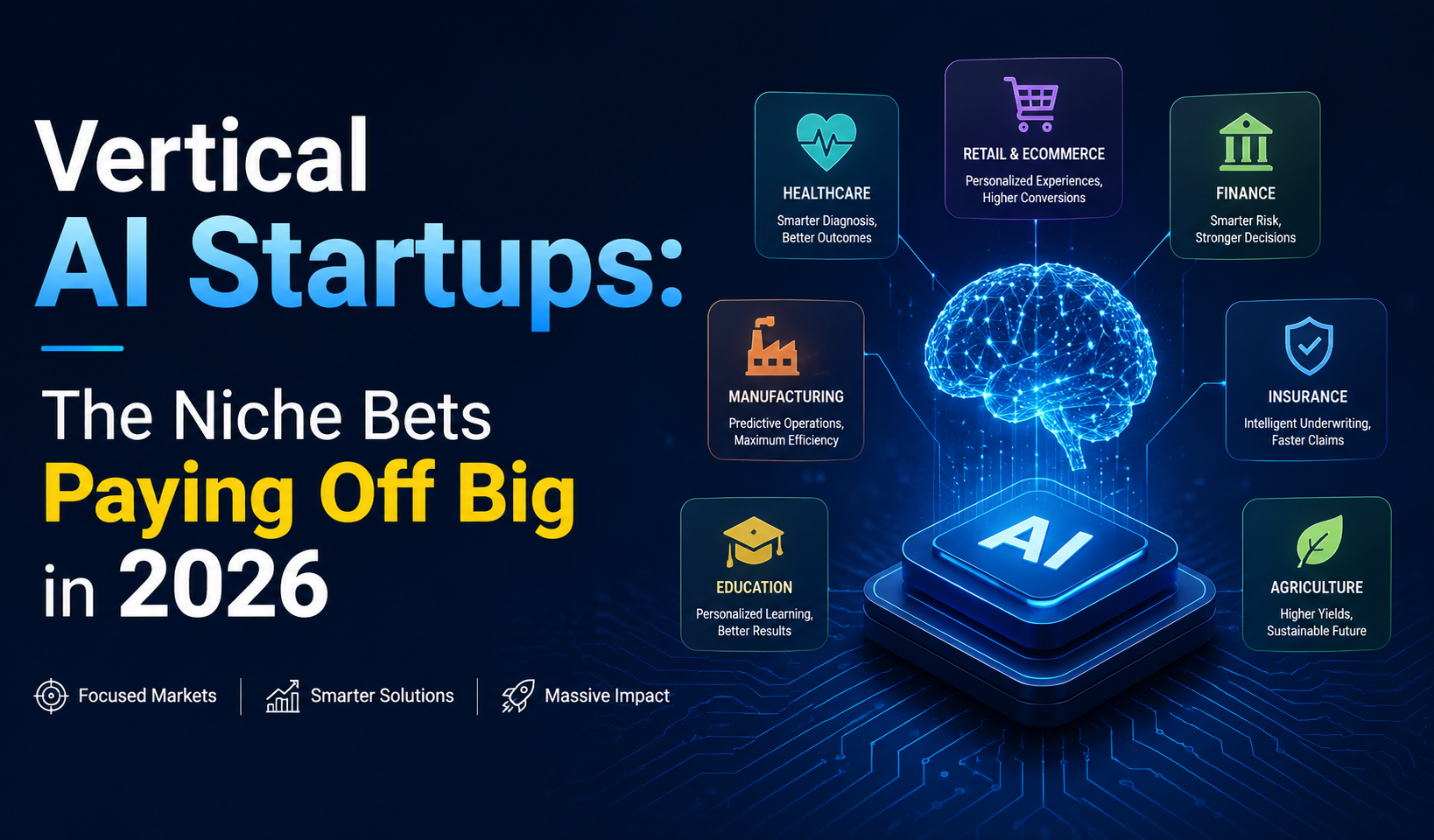
What Is a Vertical AI Startup?
A vertical AI startup develops artificial intelligence solutions designed specifically for one industry or niche market.
Unlike general AI platforms that serve a wide range of users, vertical AI startups build tools that understand industry-specific workflows, terminology, regulations, and customer needs.
Examples of Vertical AI Applications
- AI for healthcare and hospitals
- AI for legal professionals
- AI for accounting and finance
- AI for real estate
- AI for content creators
- AI for e-commerce
- AI for insurance providers
The primary goal is to automate repetitive tasks, improve decision-making, and increase productivity within a specific industry.
Why Are Vertical AI Startups Booming in 2026?
Several factors are driving the rapid growth of vertical AI startups.
Industry-Specific Business Needs
Generic AI tools often require significant customization. Vertical AI solutions are built around existing industry workflows, making them easier to implement.
Higher Accuracy
Models trained using industry-specific data produce more reliable and relevant results because they understand specialized terminology and regulations.
Faster Return on Investment (ROI)
Businesses save time, reduce operational costs, and improve productivity more quickly by adopting specialized AI solutions.
Easier Customer Acquisition
Instead of competing in crowded general AI markets, startups can focus on serving one specific industry with tailored solutions.
Vertical AI vs. General AI: What’s the Difference?
General AI platforms provide broad capabilities such as writing, coding, and answering general questions.
Vertical AI focuses on solving specialized problems within a specific industry.
Comparison
| General AI | Vertical AI |
|---|---|
| Writes emails | Reviews legal contracts |
| Creates presentations | Interprets medical images |
| Answers general questions | Detects insurance fraud |
| Generates code | Optimizes manufacturing processes |
| Brainstorms ideas | Automates mortgage underwriting |
Vertical AI combines advanced AI capabilities with deep industry expertise.
Which Industries Offer the Biggest Opportunities for Vertical AI?
AI adoption is accelerating across multiple industries.
Healthcare
Vertical AI helps healthcare providers by:
- Managing medical records
- Scheduling patients
- Assisting with diagnosis
- Supporting clinical decision-making
- Processing insurance claims
Doctors spend less time on paperwork and more time caring for patients.
Legal Services
Legal AI can:
- Review contracts
- Summarize legal documents
- Analyze case law
- Draft agreements
- Identify legal risks
Law firms become more efficient while reducing research time.
Financial Services
Financial AI supports:
- Fraud detection
- Credit risk analysis
- Risk management
- Investment research
- Customer support
Banks benefit from faster decisions and improved compliance.
Manufacturing
Manufacturing AI improves:
- Predictive maintenance
- Quality inspection
- Supply chain forecasting
- Inventory management
- Production planning
Factories reduce downtime and improve operational efficiency.
Real Estate
AI supports real estate professionals through:
- Property valuation
- Lead qualification
- Market forecasting
- Document management
- Virtual property recommendations
Agents save significant time on repetitive tasks.
Education
Education-focused AI helps schools by:
- Personalizing learning experiences
- Automating grading
- Creating lesson plans
- Tracking student progress
- Providing tutoring assistance
Students receive more personalized education.
Agriculture
Agricultural AI improves farming through:
- Crop monitoring
- Disease detection
- Irrigation optimization
- Weather forecasting
- Crop yield prediction
Real-time insights help farmers make smarter decisions.
Why Are Investors Interested in Vertical AI Startups?
Vertical AI startups offer several attractive qualities for investors.
Large Market Potential
Even highly specialized industries often represent multi-billion-dollar opportunities.
High Switching Costs
Once AI becomes integrated into daily business operations, companies are less likely to switch providers.
Recurring Revenue
Most vertical AI companies operate on subscription-based business models, creating predictable monthly income.
Strong Customer Retention
Industry-specific software becomes essential to business operations, leading to long-term customer relationships.
What Technologies Power Vertical AI Startups?
Most vertical AI companies combine several advanced technologies.
Common Technologies Include
- Large Language Models (LLMs)
- Machine Learning
- Computer Vision
- Speech Recognition
- Predictive Analytics
- Workflow Automation
- Cloud Computing
- Retrieval-Augmented Generation (RAG)
- AI Agents
- Industry-Specific Data Sets
Together, these technologies create highly specialized AI solutions.
What Are AI Agents and Why Do They Matter?
AI agents are autonomous software systems capable of completing tasks with minimal human intervention.
Common AI Agent Tasks
- Scheduling meetings
- Reviewing reports
- Completing paperwork
- Processing invoices
- Responding to customer inquiries
- Managing business workflows
Many vertical AI startups are developing AI agents tailored to specific industries.
What Challenges Do Vertical AI Startups Face?
Despite significant opportunities, vertical AI startups encounter several challenges.
Data Privacy
Sensitive industries such as healthcare and finance require strict data protection.
Regulatory Compliance
AI solutions must comply with industry regulations and legal standards.
Building Customer Trust
Businesses need confidence that AI recommendations are accurate and reliable.
System Integration
AI platforms must integrate seamlessly with existing business software.
Increasing Competition
As vertical AI grows, more startups are entering the market.
What Business Models Do Vertical AI Companies Use?
Most successful companies rely on recurring revenue models.
Common Pricing Models
- Monthly SaaS subscriptions
- Usage-based pricing
- Enterprise licensing
- Per-user pricing
- API access
- Custom enterprise solutions
Recurring revenue provides financial stability and attracts investors.
How Do Vertical AI Startups Build Competitive Advantages?
Successful companies focus on expertise rather than building the largest AI model.
Key Competitive Advantages
- Deep industry knowledge
- Proprietary datasets
- Regulatory expertise
- Specialized workflows
- Exceptional customer support
- Continuous AI model improvement
These strengths are difficult for general AI platforms to replicate.
Are Vertical AI Startups Replacing Human Jobs?
Not entirely.
Most companies use AI to automate repetitive work while allowing employees to focus on higher-value responsibilities.
Examples
- Doctors spend more time with patients.
- Lawyers focus on legal strategy instead of document review.
- Accountants provide financial advice rather than manual bookkeeping.
- Customer support teams handle complex cases while AI answers routine questions.
The future is centered on human-AI collaboration rather than human replacement.
What Skills Are Needed to Build a Vertical AI Startup?
Successful founders combine technical expertise with industry knowledge.
Essential Skills
- AI development
- Product management
- Industry experience
- Customer research
- Data engineering
- Regulatory knowledge
- Sales and marketing
- Business operations
Understanding customer problems is often more valuable than building the most advanced AI model.
What Are the Biggest Vertical AI Trends for 2026 and Beyond?
Several trends are expected to shape the future of vertical AI.
Autonomous AI Agents
Businesses will increasingly deploy AI assistants to automate routine operations.
Industry-Specific Foundation Models
More organizations will train AI models using specialized industry data.
Stronger Compliance Features
AI platforms will include built-in governance, auditing, and regulatory controls.
Better Software Integration
Vertical AI solutions will integrate seamlessly with existing enterprise software.
Increased Personalization
AI systems will adapt to each company’s unique workflows and preferences.
How Should Businesses Choose the Right Vertical AI Platform?
Before investing, businesses should evaluate several important factors.
Look for Platforms That Offer
- Deep industry expertise
- Proven accuracy
- Transparent pricing
- Easy integration
- Reliable customer support
- Strong data security
- Regulatory compliance
- Scalable infrastructure
- Positive customer case studies
Starting with a pilot project can help businesses validate the platform before full implementation.
Are Vertical AI Startups a Good Investment Opportunity?
Many analysts consider vertical AI one of the strongest startup opportunities in 2026.
Companies that solve highly specialized industry problems often build sustainable businesses with loyal customers and recurring revenue.
The greatest opportunities exist in industries where manual processes remain common, regulations are complex, and automation delivers measurable financial benefits.
Also Read:-
The Founder’s Dilemma: Scale Fast or Scale Smart?
The Billion-Dollar Blueprint: Startup Growth Secrets Revealed
Hustle Culture Is Dead: Here’s What Replaced It