Table of Contents
ToggleIntroduction
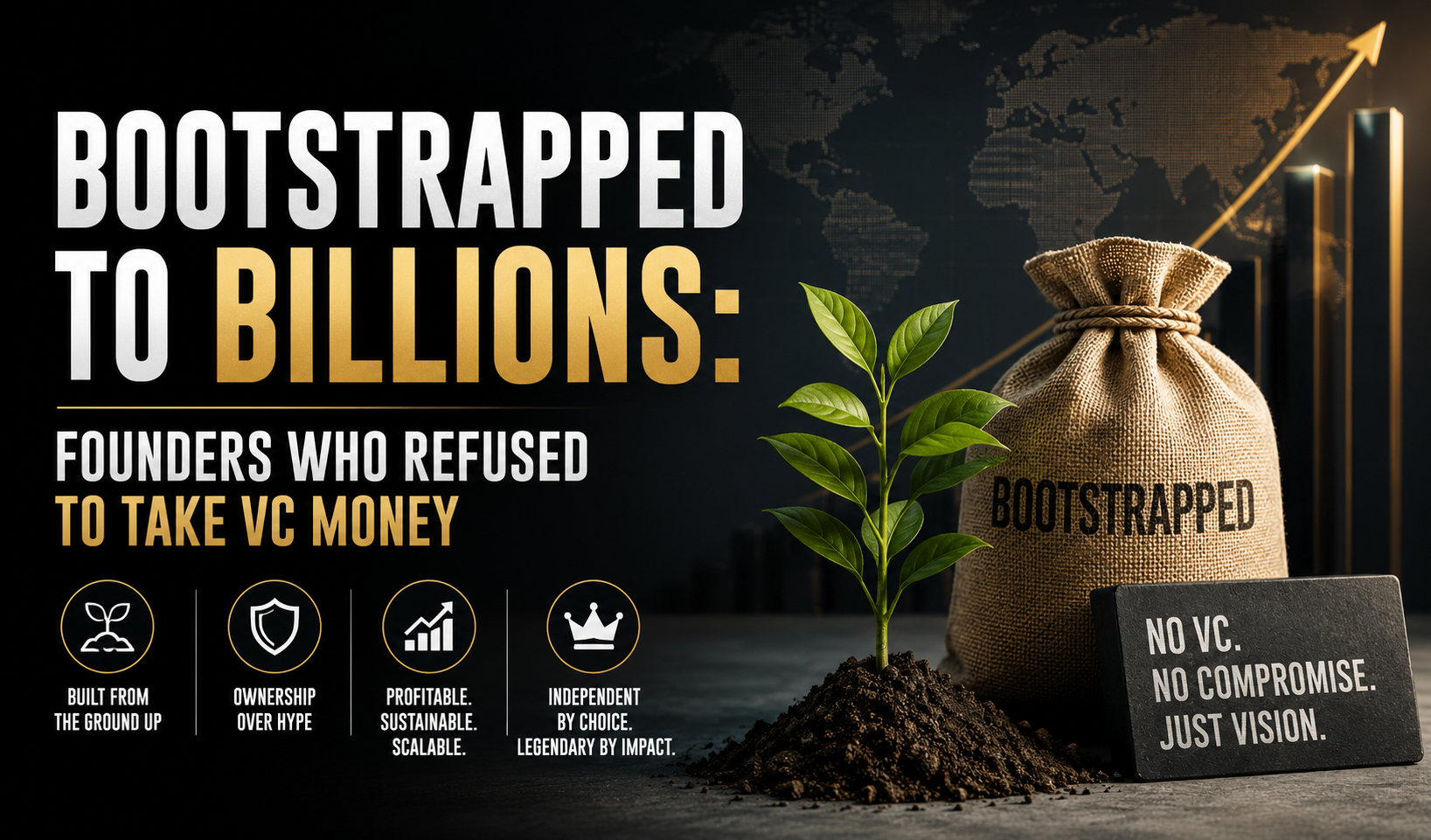
Starting a business without venture capital (VC) may seem challenging in today’s startup ecosystem, but many of the world’s most successful entrepreneurs have proven that it is possible to build billion-dollar companies without giving up equity. Instead of relying on investors, these founders focused on customer revenue, disciplined spending, innovation, and long-term growth.
If you’re wondering whether bootstrapping is still a viable path in 2026, the answer is yes. While venture capital can accelerate expansion, many entrepreneurs prefer maintaining full ownership and complete control over their businesses. Below are the most frequently asked questions about bootstrapped billion-dollar companies and the founders who built them.
What does “bootstrapped” mean in business?
Answer
A bootstrapped business is a company that grows primarily through its own revenue rather than outside investment. Founders typically use personal savings, business profits, or customer payments to finance operations.
Bootstrapping allows entrepreneurs to:
- Retain full ownership
- Make independent business decisions
- Focus on sustainable profitability
- Build without investor pressure
What is a bootstrapped billion-dollar company?
Answer
A bootstrapped billion-dollar company is a business that reaches a valuation exceeding $1 billion without raising traditional venture capital funding.
These companies demonstrate that consistent execution, customer satisfaction, and profitability can create extraordinary long-term value without external investors.
Why do some founders avoid venture capital?
Answer
Many entrepreneurs choose not to raise VC funding because they want to:
- Keep complete ownership
- Maintain decision-making authority
- Focus on profitability
- Avoid investor pressure
- Build long-term businesses
- Preserve company culture
For many founders, independence is more valuable than rapid expansion.
Can a company become a unicorn without VC funding?
Answer
Yes.
Several companies have reached billion-dollar valuations while remaining fully or largely bootstrapped. Although venture capital can help businesses scale faster, it is not the only route to becoming a unicorn.
Strong products, loyal customers, recurring revenue, and sound financial management can all lead to exceptional long-term success.
Which famous companies were built without venture capital?
Answer
Several globally recognized businesses grew with little or no traditional VC funding, including:
- Mailchimp
- Basecamp
- Zoho
- Shutterstock
- Spanx
- Craigslist
These companies prove that profitable growth can outperform aggressive fundraising strategies.
How did Mailchimp become a billion-dollar business?
Answer
Mailchimp started as a side project focused on helping small businesses with email marketing.
Instead of raising venture capital, the founders reinvested profits back into the business year after year. By concentrating on customer needs and maintaining financial discipline, Mailchimp eventually became one of the world’s leading marketing platforms before its multibillion-dollar acquisition.
Why is Zoho considered one of the greatest bootstrapped success stories?
Answer
Zoho built a global software company by prioritizing product quality over fundraising.
The company gradually expanded across CRM, accounting, collaboration software, productivity tools, and cloud services while remaining independent.
Its long-term strategy allowed continuous innovation without relying on venture capital.
How did Basecamp succeed without investors?
Answer
Basecamp focused on solving real customer problems rather than chasing rapid expansion.
The founders emphasized profitability from day one, maintained a lean team, and controlled expenses carefully.
Their approach proved that sustainable businesses can outperform companies focused solely on growth metrics.
What makes bootstrapped companies different from VC-backed startups?
Answer
Bootstrapped companies typically prioritize:
- Profitability
- Customer satisfaction
- Positive cash flow
- Sustainable growth
- Operational efficiency
VC-backed startups often prioritize:
- Rapid expansion
- Market dominance
- Aggressive hiring
- Continuous fundraising
- High-growth targets
Neither model is inherently better—the right choice depends on the founder’s vision and business goals.
What are the biggest advantages of bootstrapping?
Answer
Bootstrapping offers several major benefits.
Full Ownership
Founders retain a larger share of their company and future profits.
Complete Control
Major business decisions remain with the founders.
Sustainable Growth
Growth is driven by customer demand instead of funding cycles.
Financial Discipline
Limited resources encourage efficient operations and smart spending.
Long-Term Flexibility
Founders can pursue strategies aligned with their long-term vision.
What are the challenges of bootstrapping?
Answer
Bootstrapping also comes with challenges, including:
- Limited startup capital
- Slower expansion
- Smaller marketing budgets
- Limited hiring opportunities
- Higher financial risk
Success often requires patience, resilience, and disciplined financial planning.
Is bootstrapping better than raising venture capital?
Answer
There is no one-size-fits-all answer.
Bootstrapping is ideal for businesses with:
- Strong recurring revenue
- Low capital requirements
- Profitable business models
- Sustainable growth opportunities
Venture capital may be more appropriate for industries requiring significant upfront investment, such as biotechnology, advanced hardware, or infrastructure-intensive technology.
How do bootstrapped startups fund growth?
Answer
Most bootstrapped companies finance growth through:
- Customer revenue
- Personal savings
- Business profits
- Bank financing
- Strategic partnerships
- Revenue-based financing
Instead of selling equity, they continuously reinvest earnings into growth.
Which industries are best suited for bootstrapping?
Answer
Bootstrapping works particularly well in industries such as:
- Software as a Service (SaaS)
- Consulting
- Digital marketing
- E-commerce
- Education technology
- Online media
- Professional services
- Creative agencies
These sectors often require lower upfront investment while generating recurring revenue.
What habits do successful bootstrapped founders share?
Answer
Most successful bootstrapped entrepreneurs consistently:
- Solve genuine customer problems
- Build products customers willingly pay for
- Control expenses carefully
- Focus on profitability
- Avoid unnecessary debt
- Continuously improve products
- Hire cautiously
- Think long term
Their goal is to create enduring businesses rather than chasing short-term valuations.
Can bootstrapped startups grow faster today?
Answer
Yes.
Modern technology has made bootstrapping more accessible than ever.
Cloud computing, artificial intelligence, automation, remote work, subscription software, and digital marketing have significantly lowered the cost of launching and scaling businesses.
Today’s entrepreneurs can reach global customers with fewer resources than ever before.
Should first-time founders bootstrap before seeking investment?
Answer
For many entrepreneurs, the answer is yes.
Bootstrapping allows founders to:
- Validate product-market fit
- Understand customer needs
- Generate early revenue
- Improve operations
- Build credibility
Even if investment is sought later, demonstrating traction and profitability often leads to stronger negotiating positions and better funding terms.
What lessons can entrepreneurs learn from bootstrapped billionaires?
Answer
Some of the most valuable lessons include:
- Revenue matters more than hype.
- Customer satisfaction drives sustainable growth.
- Profitability creates freedom.
- Ownership compounds wealth.
- Patience often outperforms speed.
These principles remain relevant regardless of industry or company size.
Is bootstrapping still relevant in 2026?
Answer
Absolutely.
While venture capital continues to support innovation, more entrepreneurs are embracing sustainable business models centered on profitability and efficient growth.
With affordable technology, global digital markets, and powerful automation tools, founders today have more opportunities than ever to build successful companies without sacrificing ownership.
Final Thoughts
Conclusion
The stories of bootstrapped billion-dollar founders prove that remarkable success does not always require venture capital. By focusing on customers, profitability, disciplined execution, and long-term value creation, entrepreneurs can build resilient businesses while maintaining independence.
Whether you’re launching a SaaS platform, an e-commerce brand, a consulting firm, or a digital service, bootstrapping remains one of the most effective paths to sustainable success. Although the journey may take longer, retaining ownership, preserving control, and creating lasting value are rewards that many founders consider well worth the effort.
Also Read:-
The Fundraising Formula: What Investors Want in 2026
From Garage to Global: Founders Who Built Empires Today
Vertical AI Startups: The Niche Bets Paying Off in 2026