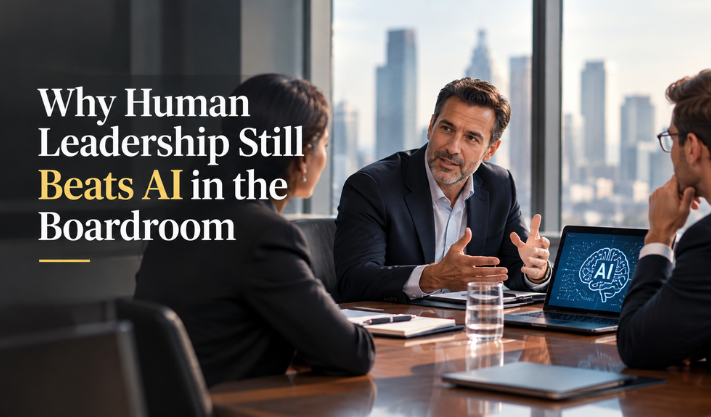
Artificial intelligence is rapidly changing how companies analyze data, predict trends, automate processes, and make strategic recommendations. From financial forecasting to risk analysis, AI can process enormous amounts of information in seconds. Yet, despite these capabilities, one question remains important: Can AI replace human leadership in the boardroom?
The answer is increasingly clear: AI can strengthen executive decision-making, but human leadership remains essential. Boards are not simply places where data is reviewed and decisions are calculated. They are environments where people evaluate uncertainty, understand relationships, consider ethics, manage conflict, and take responsibility for difficult choices.
What Is Human Leadership in the Boardroom?
Leadership Combines Judgment, Experience, and Responsibility
Human leadership is the ability of executives and board members to combine knowledge, judgment, experience, emotional intelligence, and responsibility when making organizational decisions.
Unlike an AI system, a human leader understands that a business decision can affect employees, customers, investors, communities, and partners in different ways. Leadership therefore involves more than identifying the most statistically likely outcome.
A strong board leader asks questions such as: What is the long-term impact? Who will be affected? Is this decision consistent with our values? Can the organization defend this decision publicly?
These questions require context and judgment that cannot always be reduced to data.
Why Can AI Not Fully Replace Boardroom Leadership?
Human Leaders Remain Accountable for Decisions
AI is extremely effective at identifying patterns, processing information, generating forecasts, and presenting possible scenarios. However, it does not possess human accountability in the traditional sense.
A board must ultimately take responsibility for its decisions. If a strategic acquisition fails, a major restructuring harms employee morale, or an ethical controversy damages the company’s reputation, stakeholders expect leaders to explain and own the decision.
AI can provide recommendations, but human executives remain responsible for deciding whether those recommendations should be followed. This distinction makes human leadership particularly important at the highest levels of an organization.
How Does Human Judgment Improve Strategic Decisions?
Experience Helps Leaders Interpret Uncertainty
Business decisions rarely happen under perfect conditions. Leaders frequently work with incomplete information, conflicting priorities, unexpected events, and uncertain outcomes.
AI can calculate probabilities based on available information, but experienced leaders can recognize when the available information itself may be misleading.
For example, historical data might suggest that entering a particular market is financially attractive. A CEO may still decide against entering because of cultural differences, political uncertainty, reputational concerns, or changes that have not yet appeared in the data.
Human judgment provides the ability to interpret information within a broader context.
Why Is Emotional Intelligence Important in the Boardroom?
Leadership Requires Empathy and Human Connection
Leadership is fundamentally a human activity. Board members must communicate with CEOs, executives, employees, investors, and other stakeholders.
They may need to resolve disagreements, manage difficult conversations, motivate teams, and build trust during periods of uncertainty.
Emotional intelligence helps leaders understand how people are responding to a decision rather than simply whether the decision makes financial sense. AI can analyze sentiment and communication patterns, but human leaders can build genuine relationships and respond to emotions with empathy and understanding.
This becomes especially important during layoffs, leadership transitions, mergers, crises, and major organizational changes.
Can AI Help Boards Make Better Decisions?
AI Works Best as a Decision-Support Tool
Yes. AI can become an important decision-support tool for modern boards. It can analyze financial information, identify unusual patterns, summarize large reports, monitor market developments, compare scenarios, and highlight potential risks.
This allows executives to spend less time collecting information and more time interpreting it.
The strongest approach is therefore not AI versus humans. It is AI supporting human leadership. A board that combines machine intelligence with human judgment can potentially make faster and more informed decisions without removing accountability from its leaders.
Why Does Ethics Require Human Leadership?
Ethical Decisions Often Go Beyond Numerical Performance
One of the biggest limitations of AI-driven decision-making is that ethical questions do not always have a single objective answer.
A company might be able to maximize short-term profits by reducing a particular investment. But should it do so if the decision creates significant social consequences?
Similarly, AI may recommend collecting additional customer data because it could improve personalization. Human leaders must decide whether that approach respects privacy expectations and organizational values.
Ethical leadership requires principles, responsibility, and consideration of consequences beyond numerical performance.
Why Is Trust Still a Human Leadership Advantage?
Stakeholders Expect Leaders to Communicate and Take Responsibility
Trust is one of the most valuable assets in business. Employees want to believe that their leaders understand their concerns. Investors want confidence that executives can navigate uncertainty. Customers expect companies to behave responsibly.
Human leaders build trust through consistent actions, communication, transparency, and accountability.
An AI system can produce an accurate recommendation, but stakeholders typically still look to people when they want reassurance, explanation, and responsibility. The ability to stand behind a decision remains a powerful leadership advantage.
How Does Human Creativity Influence Boardroom Decisions?
Leaders Can Challenge Existing Assumptions
Strategic leadership also requires imagination. Companies sometimes need to create entirely new markets, develop unconventional products, change business models, or respond to problems that have no historical precedent.
AI can generate ideas by identifying patterns across existing information. Human leaders can challenge assumptions and imagine possibilities that do not yet have sufficient historical data.
Many transformative business decisions begin with a question that sounds unreasonable at first. Human creativity gives leaders the freedom to explore those possibilities.
What Happens When AI Recommendations Conflict With Human Values?
Human Oversight Keeps Technology Aligned With Organizational Goals
This is where leadership becomes particularly important. AI systems are designed around objectives, data, models, and defined parameters.
If an AI recommendation conflicts with a company’s ethical standards, long-term strategy, or stakeholder expectations, human leaders must be able to reject it.
The right question is not always, “What does the AI recommend?” Instead, leaders should ask, “Why is the AI recommending this, what assumptions are behind it, and does it align with our goals and responsibilities?”
Human oversight ensures that technology remains a tool rather than becoming the ultimate authority.
Why Is Accountability More Important at the Executive Level?
Higher-Level Decisions Carry Greater Consequences
The higher the level of decision-making, the greater the consequences. A board can influence employment, investment, corporate strategy, acquisitions, product direction, and organizational culture.
Mistakes at this level can affect thousands of people. Because of this, decision-making requires clear accountability.
Human leaders can be questioned, challenged, evaluated, and held responsible by shareholders and stakeholders. AI cannot assume corporate responsibility in the same way.
This makes human oversight essential for responsible governance.
Will AI Change the Role of CEOs and Board Members?
Future Leaders Will Need Both Technology and Human Skills
Absolutely. AI is likely to change what leaders spend their time doing.
Executives may rely less on manually reviewing large amounts of information and more on asking strategic questions, evaluating AI-generated scenarios, managing organizational change, and making high-impact decisions.
Future leaders will therefore need two capabilities: technological literacy and distinctly human leadership skills. They will need to understand what AI can do while also knowing when its recommendations should be questioned.
What Does the Future Boardroom Look Like?
AI and Human Leaders Will Work Together
The future boardroom will probably not be human-only or AI-only. It will be a collaborative environment where technology handles large-scale analysis while people provide judgment, context, ethics, creativity, and accountability.
AI may tell leaders what is happening, identify potential outcomes, and highlight risks. Human leaders will still need to decide what matters most and what the organization should do next.
The competitive advantage will increasingly come from combining these capabilities rather than choosing between them.
Why Will Human Leadership Continue to Matter?
Leadership Requires More Than Intelligence and Data
AI can process information faster than people, but leadership is about more than information processing. It involves understanding people, managing uncertainty, interpreting values, building trust, communicating vision, and accepting responsibility for difficult decisions.
The boardroom of the future will undoubtedly become more intelligent through AI. However, intelligence alone does not equal leadership.
The most effective organizations will use AI to improve the quality and speed of decision-making while keeping humans firmly responsible for strategy, ethics, culture, and accountability.
Also Read:-
Why Some Founders Fail Fast and Others Fail Forward Today
The New Rules of Executive Leadership in the AI Era
Why Every CEO Needs an AI Strategy for Business Success