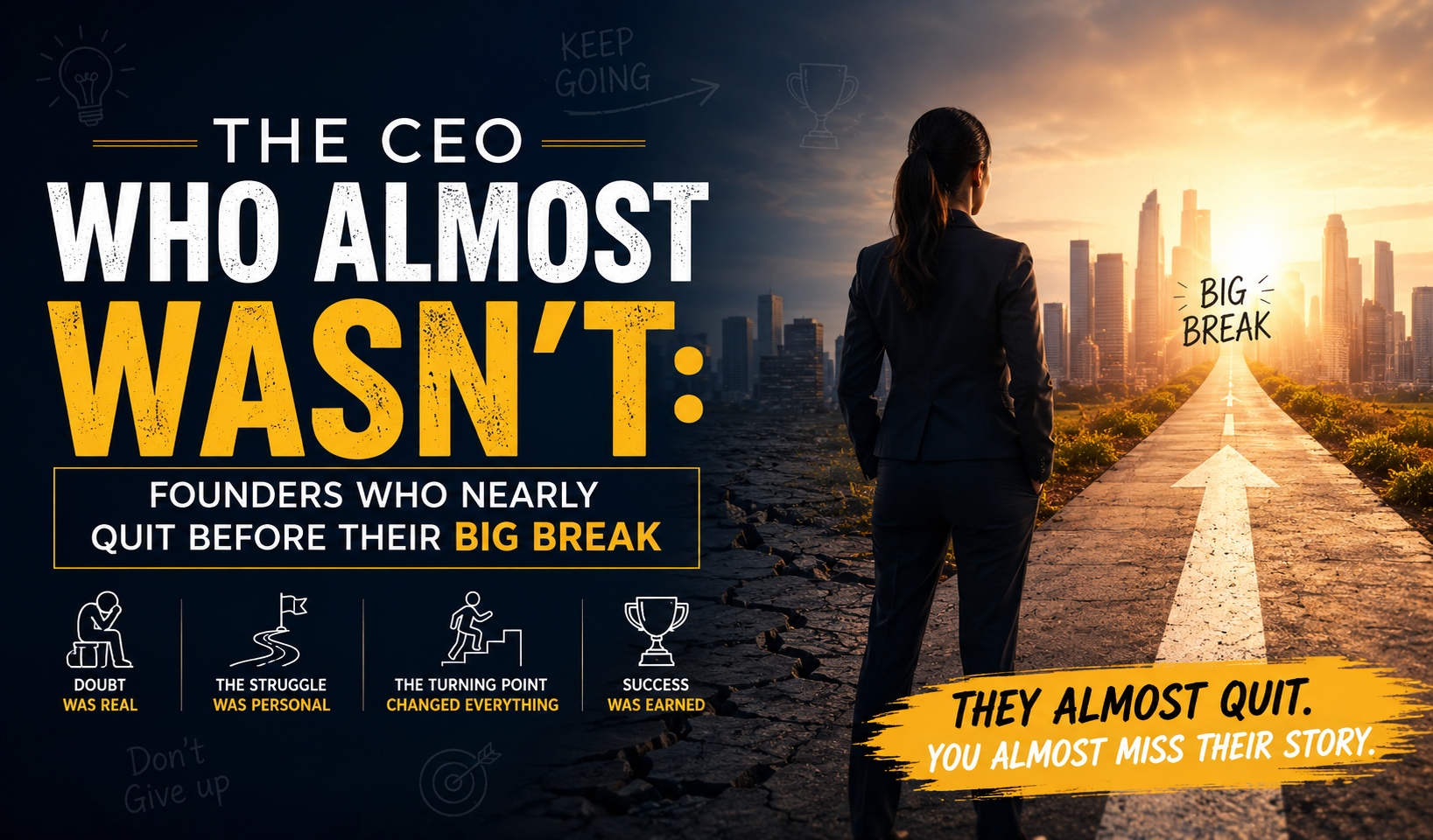
Success stories often make entrepreneurship look smooth and inevitable. In reality, many of the world’s most successful CEOs came incredibly close to giving up before achieving their biggest breakthroughs. Financial pressure, repeated failures, investor rejection, and personal doubts nearly ended their journeys.
Table of Contents
ToggleWhat does “The CEO Who Almost Wasn’t” mean?
“The CEO Who Almost Wasn’t” refers to entrepreneurs who nearly abandoned their businesses before eventually building successful companies. Many founders experience moments where quitting seems like the only logical option.
These moments often happen because of:
- Running out of funding
- Slow business growth
- Product failures
- Market uncertainty
- Personal burnout
- Multiple investor rejections
- Loss of confidence
Many successful CEOs admit that the hardest part of entrepreneurship came long before their companies became profitable.
Why do so many founders think about quitting?
Almost every entrepreneur faces moments of doubt. Building a company requires making difficult decisions while dealing with uncertainty every day.
Common reasons founders nearly quit include:
Financial stress
Many startups operate with limited cash. Founders often invest personal savings before generating consistent revenue.
Constant rejection
Investors, customers, and partners may reject an idea dozens—or even hundreds—of times before someone finally says yes.
Slow progress
Growth rarely happens overnight. Months or years of hard work may produce very little visible success.
Emotional exhaustion
Working long hours without immediate results can lead to burnout and self-doubt.
Which famous CEOs nearly gave up before succeeding?
Several globally recognized business leaders experienced moments where quitting seemed inevitable.
Steve Jobs
Before Apple became one of the world’s most valuable companies, Steve Jobs was removed from the company he founded. Rather than quitting entrepreneurship, he started new ventures, including NeXT and Pixar. His return to Apple helped reshape the technology industry.
Howard Schultz
Howard Schultz struggled to convince investors that Americans would embrace premium coffee shops. He reportedly faced hundreds of rejections before expanding Starbucks into a global brand.
Brian Chesky
The Airbnb founders experienced years of financial hardship. They even sold novelty cereal boxes during a U.S. election simply to keep the company alive while searching for product-market fit.
Sara Blakely
Before launching Spanx, Sara Blakely received numerous manufacturing rejections and had no fashion industry experience. Persistence eventually helped her build a billion-dollar business.
Jack Ma
Before Alibaba became an e-commerce giant, Jack Ma faced repeated job rejections, business setbacks, and skepticism from investors. His persistence became one of his defining leadership traits.
Is nearly quitting actually common among startup founders?
Yes.
Entrepreneurship experts consistently find that many startup founders experience periods where they seriously consider shutting down their businesses.
Reasons include:
- Lack of funding
- Product uncertainty
- Hiring challenges
- Customer acquisition problems
- Competitive pressure
- Mental fatigue
Thinking about quitting does not necessarily mean a business will fail. Sometimes it simply reflects the difficult reality of building a company.
How do successful founders know when to keep going?
Successful entrepreneurs rarely continue blindly. Instead, they evaluate whether the business still has genuine potential.
They often ask questions such as:
- Are customers finding value in the product?
- Is growth improving, even slowly?
- Have we learned something important from recent failures?
- Can the business model be adjusted?
- Are we solving a real problem?
Persistence works best when combined with learning and adaptation.
What is the difference between persistence and stubbornness?
This is one of the most important questions in entrepreneurship.
Persistence means:
- Learning from mistakes
- Improving the product
- Listening to customers
- Testing new strategies
- Adapting to market changes
Stubbornness means:
- Ignoring feedback
- Refusing necessary changes
- Repeating unsuccessful strategies
- Avoiding difficult decisions
The best CEOs know when to pivot while staying committed to their larger mission.
What lessons can entrepreneurs learn from founders who nearly quit?
Several leadership lessons appear repeatedly across successful founder stories.
Failure is part of growth
Most successful companies experience setbacks before achieving momentum.
Rejection is normal
Investors, customers, and media may initially reject ideas that later become successful businesses.
Small improvements matter
Progress often happens gradually before accelerating unexpectedly.
Adaptability creates opportunity
Founders who adjust their products based on customer feedback tend to improve their chances of long-term success.
Resilience is a competitive advantage
Entrepreneurs who recover quickly from setbacks often outperform those who expect immediate success.
Can failure actually improve leadership?
Yes.
Many CEOs say their biggest failures taught lessons they could never have learned through success alone.
Failure often helps leaders:
- Improve decision-making
- Build emotional resilience
- Strengthen communication
- Better understand customers
- Manage risk more effectively
- Develop stronger company cultures
The experience gained during difficult periods often becomes a valuable leadership asset.
What warning signs should founders pay attention to before deciding to quit?
Not every struggling business should continue indefinitely.
Founders should carefully evaluate situations where:
- Customer demand remains extremely low despite repeated improvements.
- The business model is financially unsustainable.
- Personal health is suffering significantly.
- Market conditions have fundamentally changed.
- Legal or operational risks become overwhelming.
Seeking advice from mentors, experienced entrepreneurs, or advisors can provide valuable perspective before making a final decision.
How can founders stay motivated during difficult periods?
Maintaining motivation requires more than positive thinking.
Helpful strategies include:
- Setting smaller, achievable milestones
- Celebrating incremental progress
- Seeking feedback from customers
- Building a trusted support network
- Learning continuously
- Managing physical and mental well-being
- Remembering the original purpose behind the business
Many founders discover that consistent routines help them remain focused during uncertain times.
Does every successful CEO experience major setbacks?
Not every founder follows the same path, but setbacks are extremely common in entrepreneurship.
Challenges may include:
- Product launches that fail
- Funding rounds that collapse
- Hiring mistakes
- Economic downturns
- Market competition
- Customer losses
What often separates successful CEOs is not the absence of failure but their ability to respond constructively and keep improving.
What is the biggest takeaway from founders who nearly quit?
The biggest lesson is that success rarely follows a straight line.
Many well-known CEOs faced moments when giving up seemed reasonable. Instead of expecting instant success, they continued learning, adapting, and refining their businesses until opportunities emerged.
This does not mean every entrepreneur should never quit. Sometimes closing one venture creates the opportunity to build something stronger. The key is making thoughtful decisions based on evidence, customer needs, and long-term goals rather than temporary setbacks.
For aspiring entrepreneurs, these stories offer a realistic perspective: persistence matters, but so do adaptability, resilience, and a willingness to evolve. The CEO who almost wasn’t may become the leader who changes an entire industry simply because they chose to take one more step forward when success still seemed out of reach.
Who are some CEOs who almost quit before succeeding?
Steve Jobs, Howard Schultz, Brian Chesky, Sara Blakely, and Jack Ma all faced major setbacks before building highly successful companies.
Why do startup founders think about quitting?
Financial pressure, investor rejection, burnout, slow growth, and uncertainty are among the most common reasons.
Should entrepreneurs always keep going?
No. Entrepreneurs should evaluate customer demand, financial sustainability, and market conditions before deciding whether to persist, pivot, or move on.
What is the difference between persistence and stubbornness?
Persistence involves learning and adapting, while stubbornness means refusing to change despite evidence.
What is the biggest lesson from founders who nearly quit?
Long-term success often comes from resilience, continuous improvement, and the ability to adapt when challenges arise.
Also Read:-
Remote-First, Profit-First: Building a Global Team Successfully
Disruption on Demand: Industries Ripe for the Next Big Startup
Crypto Comebacks: Entrepreneurs Rebuilding Wealth in Web3