Table of Contents
ToggleIntroduction
Artificial intelligence (AI) is transforming nearly every industry. From automating customer service to analyzing business data in seconds, AI has become an essential tool for modern organizations. Yet despite its remarkable capabilities, AI cannot replace the qualities that define exceptional leadership.
The world’s most successful CEOs understand that technology is a powerful assistant—not a substitute for human judgment, empathy, ethics, creativity, and vision. As AI continues to reshape workplaces, the leaders who thrive will be those who combine technological innovation with deeply human skills.
What does “What AI Still Can’t Replace” mean?
It refers to the human abilities that remain beyond artificial intelligence, even as AI becomes more advanced.
These include:
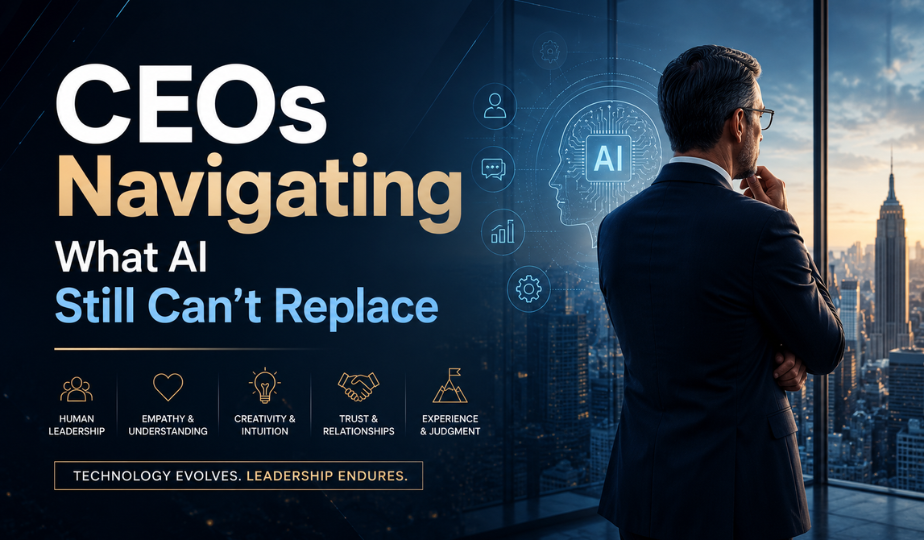
- Emotional intelligence
- Strategic vision
- Ethical decision-making
- Trust-building
- Leadership during uncertainty
- Creativity and innovation
- Relationship management
- Cultural understanding
While AI can process enormous amounts of information, it cannot genuinely understand human emotions or build authentic relationships.
Why are CEOs embracing AI instead of fearing it?
Forward-thinking CEOs recognize that AI is a productivity tool—not a leadership replacement.
They use AI to:
- Analyze large datasets
- Automate repetitive work
- Improve customer experiences
- Forecast market trends
- Increase operational efficiency
- Support decision-making
This allows executives to spend more time on strategy, innovation, partnerships, and people management.
Rather than competing with AI, successful CEOs learn how to work alongside it.
Can AI replace a CEO?
No.
AI can assist CEOs by providing insights and recommendations, but it cannot replace the responsibilities of executive leadership.
A CEO must:
- Inspire employees
- Build company culture
- Manage crises
- Negotiate partnerships
- Earn stakeholder trust
- Make ethical decisions
- Lead organizational change
These responsibilities require emotional intelligence, intuition, and accountability that AI cannot replicate.
What leadership qualities remain uniquely human?
Several qualities continue to distinguish effective CEOs from machines.
Emotional Intelligence
Employees don’t simply follow instructions—they follow leaders they trust.
Great CEOs:
- Listen carefully
- Understand employee concerns
- Resolve conflicts
- Motivate teams
- Show empathy
AI can recognize emotional patterns but cannot genuinely experience empathy.
Strategic Vision
AI predicts trends using historical data.
CEOs imagine futures that have never existed.
Visionary leaders:
- Spot emerging opportunities
- Create entirely new markets
- Build long-term strategies
- Inspire organizations around bold missions
Innovation often begins with imagination rather than data.
Ethical Judgment
Business decisions often involve difficult moral choices.
Examples include:
- Employee layoffs
- Privacy concerns
- Environmental responsibility
- Fair hiring practices
- Product safety
AI provides information, but humans remain responsible for ethical outcomes.
Building Trust
Successful companies are built on trust.
Customers trust brands.
Employees trust leaders.
Investors trust management.
Trust develops through honesty, transparency, accountability, and consistent actions—qualities that cannot be automated.
How are CEOs using AI responsibly?
Leading executives combine AI with human oversight.
Common best practices include:
- Reviewing AI-generated recommendations before acting
- Protecting customer privacy
- Monitoring algorithmic bias
- Keeping humans involved in critical decisions
- Investing in employee AI education
Responsible AI governance is becoming a major leadership priority.
Why is creativity still a competitive advantage?
AI creates content by identifying existing patterns.
Human creativity introduces original ideas.
Successful CEOs encourage:
- Experimentation
- Innovation
- Diverse thinking
- Risk-taking
- Product development
- Business model innovation
Many breakthrough ideas emerge from curiosity rather than algorithms.
How important is communication in the AI era?
Communication has become even more valuable.
Employees want leaders who explain:
- Why change is happening
- How AI affects jobs
- Future company direction
- Organizational goals
- Business priorities
Clear communication reduces uncertainty and builds confidence during digital transformation.
Can AI manage company culture?
No.
Culture develops through leadership behaviors, shared values, and employee experiences.
Strong CEOs shape culture by:
- Recognizing achievements
- Encouraging collaboration
- Promoting inclusion
- Supporting learning
- Demonstrating integrity
Technology can support workplace culture, but people create it.
What skills should future CEOs develop?
As AI handles more technical tasks, human-centered leadership becomes increasingly valuable.
Important skills include:
Strategic Thinking
Understanding long-term opportunities beyond immediate results.
Emotional Intelligence
Leading diverse teams with empathy and confidence.
Adaptability
Responding quickly to changing markets and technologies.
Decision-Making
Balancing data with experience and intuition.
Communication
Clearly explaining complex business changes.
Innovation
Encouraging new ideas and continuous improvement.
How does AI improve CEO decision-making?
AI helps executives make faster, more informed decisions by:
- Identifying market trends
- Detecting business risks
- Forecasting customer demand
- Monitoring financial performance
- Generating operational insights
However, final decisions still depend on human judgment, experience, and organizational priorities.
What industries rely most on human leadership?
Although AI is transforming every sector, industries requiring significant human interaction still depend heavily on executive leadership.
Examples include:
- Healthcare
- Education
- Financial services
- Hospitality
- Manufacturing
- Retail
- Nonprofit organizations
- Government
In these industries, relationships, trust, ethics, and leadership remain essential.
Why can’t AI replace crisis leadership?
Unexpected crises rarely follow predictable patterns.
Examples include:
- Economic downturns
- Cybersecurity incidents
- Public relations challenges
- Supply chain disruptions
- Global conflicts
During uncertainty, CEOs must:
- Stay calm
- Make rapid decisions
- Communicate transparently
- Reassure stakeholders
- Adapt strategies quickly
Human resilience becomes the greatest competitive advantage.
How are employees responding to AI in the workplace?
Most employees view AI as a helpful assistant rather than a replacement when companies communicate openly.
Employees generally value leaders who:
- Explain AI initiatives clearly
- Invest in workforce training
- Create new career opportunities
- Encourage continuous learning
- Maintain transparency
Successful CEOs focus on helping people work better with AI rather than competing against it.
What is the future of leadership in an AI-driven world?
The future belongs to leaders who successfully combine technology with humanity.
Tomorrow’s CEOs will:
- Use AI to increase efficiency
- Prioritize ethical innovation
- Invest in employee development
- Build resilient organizations
- Foster collaboration between humans and machines
Rather than replacing executives, AI will continue expanding their capabilities.
Frequently Asked Questions
Can AI completely replace CEOs?
No. AI supports decision-making but cannot replace human leadership, emotional intelligence, ethics, or strategic vision.
What leadership skill is most valuable in the AI era?
Emotional intelligence remains one of the most valuable leadership skills because it strengthens trust, communication, and team engagement.
Why is human creativity still important?
Human creativity produces original ideas, breakthrough innovations, and strategic thinking that extend beyond pattern recognition.
How should CEOs prepare for AI?
CEOs should understand AI technologies, strengthen human leadership skills, invest in workforce development, and establish responsible AI governance.
Will AI eliminate executive jobs?
AI is more likely to transform executive roles than eliminate them. Leaders who embrace AI while strengthening uniquely human capabilities will remain highly valuable.
Conclusion
Artificial intelligence is redefining how businesses operate, but it is not redefining what makes a great leader. CEOs who combine AI-driven insights with empathy, ethical judgment, creativity, resilience, and strategic vision will continue to guide organizations through change and uncertainty. The future of leadership is not about choosing between humans and AI—it is about using technology to amplify the qualities that only people can provide. As AI evolves, the CEOs who succeed will be those who lead with both intelligence and humanity.
Also Read:-
Quiet CEOs: Why Silent Leaders Are Winning in Business Today
The CEO Who Almost Wasn’t: Founders Who Nearly Quit Before Their Big Break
Remote-First, Profit-First: Building a Global Team Successfully