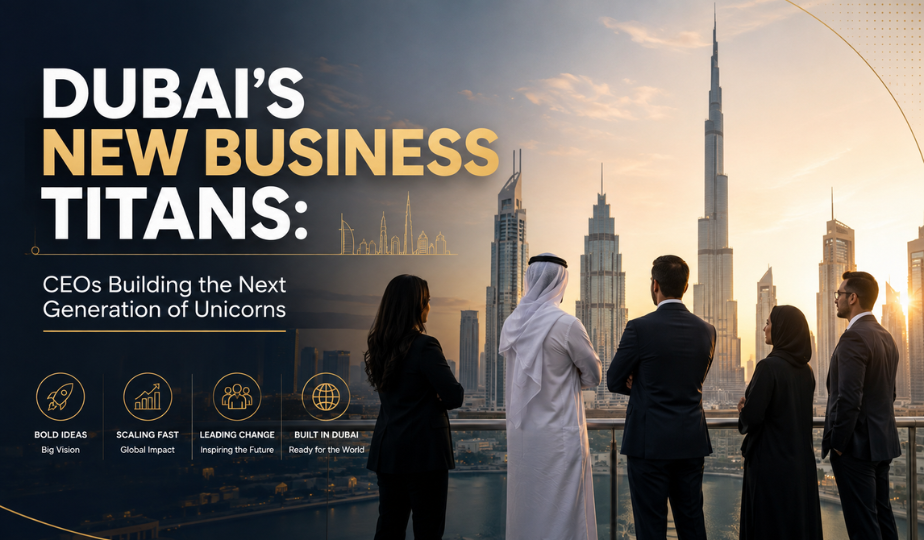
Dubai is entering a new era of entrepreneurship. The city is no longer just a regional business hub. It is becoming a launchpad for technology companies targeting markets across the Middle East and around the world.
The UAE has set ambitious goals for startup growth and the creation of more unicorn companies. Dubai is also strengthening its founder ecosystem by connecting entrepreneurs with investors, businesses, mentors, and other strategic partners.
CEOs building companies in fintech, proptech, food technology, mobility, e-commerce , and digital services are driving this growth. Their journeys provide a useful look at where Dubai’s next generation of high-growth companies could come from.
Who Are the New Business Tycoons of Dubai?
Dubai’s new business leaders are founders and CEOs who combine technology with major regional challenges. They are building businesses around payments, property, food delivery, mobility, e-commerce, and other services where digital platforms can improve customer experiences and create scalable business models.
The startup ecosystem now includes thousands of companies, with some Dubai-based businesses already reaching unicorn status. This suggests that the next major companies could be those capable of expanding beyond Dubai and solving problems across multiple markets.
Why Is Dubai a Breeding Ground for Unicorns?
Dubai offers several advantages to ambitious founders. The city provides access to international investors, global companies, a strong business community, and a diverse customer base made up of people and businesses from many countries.
Government-backed programs are also giving the startup ecosystem more structure. Dubai has introduced initiatives that connect founders with investors, companies, mentors, and ecosystem partners.
For entrepreneurs, this support is important because successful startups need more than funding. They also need customers, talent, mentors, partnerships, and access to new markets.
Who Is Mudassir Sheikha and Why Does Careem Matter?
Mudassir Sheikha is a strong example of Dubai’s technology entrepreneurship story. He co-founded Careem after identifying a major regional challenge: transportation.
Careem grew from a Dubai-based ride-hailing company into one of the region’s leading technology platforms before being acquired by Uber in a multibillion-dollar deal.
Careem’s journey proved that a company created to solve problems for Middle Eastern consumers could grow into a major regional business. Its services later expanded beyond transportation into food, groceries, payments, and other everyday services.
For Dubai’s emerging entrepreneurs, Careem offers a simple lesson: solve a local problem, understand regional customers, and then scale the technology across borders.
How Is Hosam Arab Disrupting Fintech?
Fintech is another important part of Dubai’s startup ecosystem, with Hosam Arab serving as the co-founder and CEO of Tabby.
Founded in 2019, Tabby developed a consumer finance platform focused on flexible payment options. Arab’s previous experience in e-commerce gave him valuable insight into changing consumer behavior across the Gulf.
His work reflects a wider trend in Dubai, where fintech companies are bringing payments, commerce, and financial services into simpler digital experiences.
Tabby’s growth also highlights the importance of understanding local consumers. Regional startups can compete successfully when they combine strong technology with a clear understanding of how people shop, pay, and interact with businesses.
Why Is Michael Lahyani Important to Dubai’s Proptech Story?
Property Finder founder and CEO Michael Lahyani has played an important role in changing how consumers search for property across the Middle East.
Property Finder started by addressing a simple but important problem: making property discovery easier for consumers and businesses.
The company grew into a leading regional proptech platform and expanded into several markets.
Lahyani’s journey highlights another quality of successful Dubai entrepreneurs: patience. Not every major company becomes successful within a few years. Some businesses become industry leaders by continuously improving a market over a long period.
Property Finder shows how technology can modernize traditional industries such as real estate and turn them into scalable regional businesses.
How Is Mohamad Ballout Changing Food Technology?
Mohamad Ballout, co-founder and CEO of Kitopi, demonstrates how technology can transform an industry that depends on both digital systems and physical operations.
Kitopi was created as a technology-driven food business in Dubai. Its model shows how software, data, operations, and physical infrastructure can work together.
This is important for Dubai’s startup ecosystem because the next generation of unicorns will not necessarily be pure software companies.
Some of the most successful businesses may combine technology with logistics, retail, hospitality, healthcare, property, or financial services while maintaining the ability to scale.
What Sets Dubai’s New Generation of CEOs Apart?
One of the biggest differences is how these entrepreneurs think about growth.
Traditional businesses often expand city by city. Technology-led companies can potentially serve millions of customers across multiple markets without completely rebuilding their operating models.
Dubai’s new CEOs are also increasingly focused on regional challenges. They are asking questions such as how to make payments easier, how to help consumers find property faster, how to improve restaurant efficiency, and how to make transportation and everyday services more accessible.
These challenges create opportunities for companies that can serve customers across the GCC and wider MENA region.
Are Unicorns Already Being Created in Dubai?
Yes. Dubai has already produced major technology success stories, although building a unicorn remains difficult.
Companies such as Careem and other high-growth businesses have shown that startups from the region can create significant value and attract international investment.
The challenge now is to create many more companies capable of reaching similar levels of success.
A strong startup ecosystem needs more than one or two major success stories. It requires a steady flow of entrepreneurs, investors, technology talent, and companies capable of scaling internationally.
What Sectors Could Produce Dubai’s Next Unicorns?
Several sectors stand out as potential sources of Dubai’s next major companies.
Fintech remains a strong opportunity because of the continued growth of digital payments and financial services.
Artificial intelligence could create companies focused on business automation, customer service, data analysis, and specialized industry solutions.
Proptech will continue to change property transactions, investment, and management.
Dubai’s dense urban environment and strong hospitality industry also create opportunities in food technology and logistics.
Digital commerce remains another attractive area as consumers continue to demand faster, easier, and more convenient online experiences.
The strongest companies may eventually combine several of these sectors rather than focusing on just one.
What Role Will AI Play in Dubai’s Next Startup Boom?
AI is likely to become an important layer across many industries rather than existing only as a separate business category.
Fintech startups can use AI to improve customer experiences and risk assessment. Property platforms can use it to organize listings and personalize searches. Logistics companies can use AI for forecasting, planning, and operations.
This creates opportunities for founders who understand specific industry problems.
The opportunity is therefore not only about creating another AI company. It is also about taking an existing business model and using AI to make it more efficient, faster, and more effective.
What Lessons Can Future Founders Learn From Dubai’s Business Leaders?
The first lesson is that successful companies are usually built around real problems rather than valuations.
Careem focused on transportation. Tabby focused on consumer finance and payments. Property Finder transformed property searches. Kitopi brought technology into food services.
The formula is relatively simple: identify a major need, build a product that customers genuinely want, create a strong operating model, and then expand into markets where the same problem exists.
Dubai’s startup infrastructure is becoming more mature and can provide founders with greater support. However, the CEO still has to turn the opportunity into a successful business.
What Is Next for Dubai’s Startup Ecosystem?
The next chapter for Dubai will depend on whether today’s startups can grow into tomorrow’s regional and global companies.
The ecosystem is becoming stronger. Founder-support programs are expanding, while the UAE continues to encourage entrepreneurship, investment, and the development of high-growth technology businesses.
Dubai therefore offers more than ambitious entrepreneurs. It is also developing the institutions, capital networks, partnerships, and market access that founders need to scale.
Ultimately, the new generation of Dubai CEOs will not be judged only by how quickly they make an impact. Their real success will be measured by their ability to build lasting companies that solve real problems and create value across markets.
Also Read:-
Visionary CEOs Building Global Brands from Small Beginnings
New Leadership Rules: How Modern CEOs Win Today
CEOs Using AI to Make Million-Dollar Business Decisions