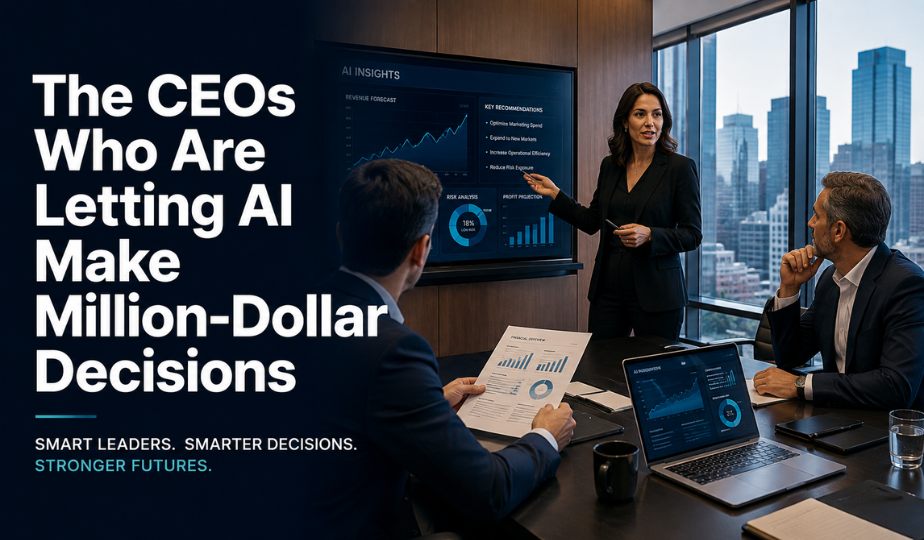
Artificial intelligence is no longer just a tool for automation. Today, many CEOs use AI to support decisions worth millions of dollars, from approving investments and optimizing supply chains to predicting customer demand and managing financial risks. While AI doesn’t replace executive leadership, it provides insights that help businesses make faster, smarter, and more profitable decisions.
Table of Contents
ToggleWhat does it mean when CEOs let AI make million-dollar decisions?
It means CEOs trust AI systems to analyze massive amounts of business data and recommend actions that influence significant financial outcomes. These decisions may involve investments, pricing, inventory management, marketing budgets, mergers, hiring strategies, or operational planning.
The final approval usually remains with the CEO or executive team, but AI often identifies the best option based on data that humans cannot process quickly.
Why are CEOs relying on AI for major business decisions?
Modern companies generate enormous volumes of data every day. Human teams cannot analyze every customer interaction, financial report, market trend, and operational metric in real time.
AI can:
- Detect hidden business patterns
- Predict future demand
- Identify financial risks
- Recommend cost-saving opportunities
- Improve forecasting accuracy
- Reduce human bias
- Speed up decision-making
This gives executives better information before making expensive business decisions.
Which industries are using AI for high-value decisions?
AI has become essential across many industries.
Financial Services
Banks use AI to evaluate lending risks, detect fraud, manage investments, and forecast market movements.
Retail
Retail CEOs use AI to predict customer demand, optimize inventory, personalize shopping experiences, and determine product pricing.
Healthcare
Healthcare organizations rely on AI to improve hospital operations, allocate medical resources, predict patient demand, and assist in medical research.
Manufacturing
Manufacturers use AI to improve production schedules, reduce equipment failures, and optimize supply chains.
Logistics
Shipping companies use AI to optimize delivery routes, reduce transportation costs, and predict supply chain disruptions.
Can AI really make better decisions than humans?
AI excels at analyzing data, recognizing patterns, and making predictions based on historical information.
Humans remain better at:
- Creativity
- Ethical judgment
- Emotional intelligence
- Leadership
- Crisis management
- Long-term vision
The most successful organizations combine AI’s analytical capabilities with human experience and strategic thinking.
What kinds of million-dollar decisions does AI influence?
AI now contributes to decisions involving:
- Business acquisitions
- Marketing investments
- Product launches
- Inventory purchasing
- Factory expansion
- Workforce planning
- Supply chain management
- Investment portfolios
- Risk management
- Customer pricing
Many of these decisions directly affect company profitability.
How does AI help CEOs reduce financial risk?
AI continuously monitors business performance and market conditions.
It can identify:
- Declining customer demand
- Supply chain disruptions
- Fraud attempts
- Cash flow problems
- Unusual spending
- Equipment failures
- Market volatility
By detecting risks early, executives can take action before problems become expensive.
Does AI replace CEOs?
No.
AI supports CEOs rather than replacing them.
Business leaders still make decisions involving ethics, company culture, legal responsibilities, employee relationships, and long-term vision.
AI acts like an intelligent advisor that provides recommendations based on data.
How does AI improve business forecasting?
Traditional forecasting often depends on historical trends and manual analysis.
AI improves forecasting by analyzing:
- Customer purchasing behavior
- Economic indicators
- Seasonal demand
- Competitor activity
- Market trends
- Weather patterns
- Global events
- Supply chain data
This enables more accurate predictions and better planning.
Are companies fully automated with AI?
Not entirely.
Most organizations use a “human-in-the-loop” approach.
AI generates recommendations, but executives review them before implementation.
This balance improves both speed and accountability.
What are the biggest advantages of AI-driven decision-making?
Businesses report several important benefits:
- Faster decisions
- Higher operational efficiency
- Better customer experiences
- Improved forecasting
- Reduced operational costs
- Lower business risks
- Smarter investments
- Increased profitability
- Data-driven strategies
These advantages help companies stay competitive in rapidly changing markets.
What challenges come with using AI?
Despite its advantages, AI also presents challenges.
Common concerns include:
- Data privacy
- Cybersecurity
- AI bias
- Limited transparency
- Regulatory compliance
- Overreliance on automation
- Employee training
- Integration with existing systems
Successful companies address these issues through governance, testing, and human oversight.
How do CEOs build trust in AI recommendations?
Executives build confidence by:
- Testing AI models before deployment
- Comparing predictions with real outcomes
- Monitoring accuracy continuously
- Maintaining human oversight
- Using high-quality data
- Updating AI systems regularly
Trust grows as AI consistently delivers reliable business insights.
Can small businesses also benefit from AI?
Yes.
AI tools are becoming more affordable for businesses of all sizes.
Small companies use AI for:
- Customer support
- Marketing automation
- Sales forecasting
- Inventory management
- Financial analysis
- Business reporting
- Customer relationship management
Cloud-based AI platforms make advanced capabilities accessible without large upfront investments.
Will AI become a standard tool for every CEO?
Most experts believe AI will become as common as spreadsheets, email, and cloud software.
Future CEOs are expected to use AI for:
- Strategic planning
- Financial forecasting
- Talent management
- Customer insights
- Market analysis
- Competitive intelligence
- Operational optimization
AI is increasingly becoming a core component of executive decision-making.
How can business leaders prepare for AI-powered leadership?
Leaders should focus on developing both technological understanding and strong leadership skills.
Recommended steps include:
- Learn AI fundamentals
- Invest in quality business data
- Encourage data-driven decision-making
- Train employees to work alongside AI
- Establish ethical AI policies
- Monitor AI performance regularly
- Balance automation with human judgment
Organizations that combine advanced technology with experienced leadership are better positioned for long-term success.
Final Thoughts
Artificial intelligence is transforming the way CEOs make high-value business decisions. Rather than replacing leadership, AI enhances it by delivering faster insights, improving forecasting, reducing risk, and uncovering opportunities that might otherwise go unnoticed.
The companies seeing the greatest success are those that treat AI as a trusted decision-support system while keeping experienced leaders responsible for strategy, ethics, and accountability. As AI technology continues to evolve, executives who embrace data-driven leadership will be better equipped to navigate uncertainty, drive innovation, and make smarter million-dollar decisions that fuel sustainable growth.