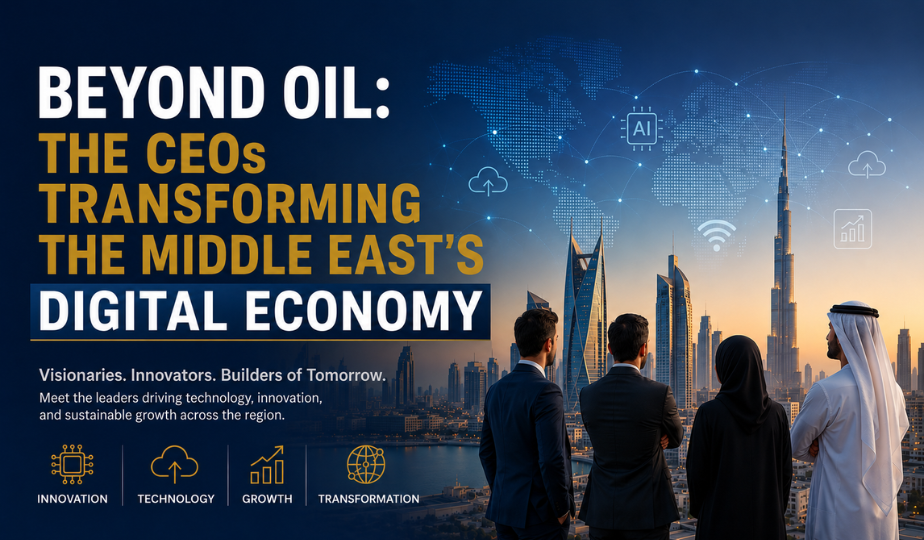
The Middle East is entering a new era of economic growth. While oil and gas remain important to many regional economies, technology, entrepreneurship, artificial intelligence, fintech, e-commerce, cloud computing, and digital infrastructure are creating new opportunities across the region. At the center of this transformation are CEOs who are building companies, attracting investment, and turning ambitious digital strategies into real businesses.
What Does “Beyond Oil” Mean for the Middle East?
“Beyond oil” refers to the region’s effort to diversify its economies beyond traditional energy industries. Governments and businesses across the Middle East are investing in technology, tourism, financial services, logistics, healthcare, education, renewable energy, and digital infrastructure.
For CEOs, this shift creates a new business environment where innovation, technology adoption, and digital talent are becoming major competitive advantages.
The goal is not necessarily to replace oil overnight. Instead, the focus is on creating additional sources of economic growth that can support the region for decades to come.
Why Is the Middle East’s Digital Economy Growing So Quickly?
Several factors are accelerating digital transformation across the region.
Governments are introducing ambitious national technology strategies, while businesses are increasing their investment in cloud platforms, artificial intelligence, cybersecurity, automation, and digital services.
At the same time, the region has a young, increasingly connected population and rapidly expanding digital consumption. Smartphone adoption, online payments, digital banking, e-commerce, and app-based services are changing how consumers interact with businesses.
This combination of government support, private investment, technology adoption, and consumer demand is creating fertile ground for digital businesses.
Who Are the CEOs Driving This Digital Transformation?
The CEOs leading the Middle East’s digital economy come from a wide range of industries. They include founders of technology startups, executives running major telecommunications companies, fintech leaders, e-commerce entrepreneurs, and executives overseeing large-scale digital transformation programs.
Their common characteristic is a focus on building scalable businesses around technology.
Rather than viewing digitalization as simply an IT function, these leaders increasingly treat technology as a core part of business strategy, customer experience, and long-term economic growth.
How Are CEOs Using Artificial Intelligence?
Artificial intelligence is becoming one of the most important technologies shaping the region’s business landscape.
CEOs are exploring AI for customer service, fraud detection, financial analysis, supply-chain management, healthcare, marketing, cybersecurity, and business automation.
Generative AI is also changing how companies produce content, analyze information, develop software, and communicate with customers.
For Middle Eastern businesses, the opportunity extends beyond adopting existing AI tools. Regional companies are also investing in local AI capabilities, data centers, digital infrastructure, and Arabic-language technologies.
This could help the region become not only a consumer of AI but also an important contributor to the global AI economy.
What Role Does Fintech Play in the Digital Economy?
Fintech is one of the strongest examples of the region’s move beyond traditional industries.
Digital banks, payment platforms, financial technology startups, and embedded-finance solutions are changing how consumers and businesses access financial services.
CEOs in the fintech sector are addressing challenges such as financial inclusion, cross-border payments, digital lending, online commerce, and mobile banking.
The expansion of fintech also supports entrepreneurs and small businesses by making financial services more accessible and increasingly digital.
How Is E-Commerce Changing Middle Eastern Business?
E-commerce has transformed consumer behavior across the region.
Customers increasingly expect fast delivery, mobile-first shopping experiences, digital payments, personalized recommendations, and convenient online services.
This has encouraged CEOs to invest in logistics, fulfillment centers, data analytics, customer-experience technology, and digital marketplaces.
The growth of e-commerce is also creating opportunities for local entrepreneurs, allowing smaller companies and independent brands to reach customers beyond their immediate markets.
Why Is Digital Infrastructure So Important?
A strong digital economy requires more than innovative applications. It needs reliable infrastructure.
Cloud computing, high-speed connectivity, cybersecurity systems, data centers, digital payment networks, and advanced telecommunications are becoming essential components of modern business.
CEOs are therefore investing heavily in the infrastructure required to support large-scale digital adoption.
The development of this infrastructure can have a multiplier effect. Better connectivity and cloud access can help startups grow, enable businesses to automate operations, and support government digital services.
Are Middle Eastern CEOs Building Global Companies?
Yes. An increasingly important trend is the emergence of Middle Eastern companies with ambitions that extend beyond regional markets.
Digital businesses can scale internationally much faster than traditional companies because software, platforms, and online services can reach customers across borders.
Regional CEOs are therefore looking beyond local markets and exploring opportunities across Africa, Asia, Europe, and other emerging economies.
This global ambition could strengthen the Middle East’s position as both a destination for technology investment and a source of globally competitive companies.
What Challenges Do These CEOs Face?
The digital transformation is not without challenges.
One major issue is the availability of highly skilled technology talent. Companies need specialists in AI, cybersecurity, software development, data science, cloud computing, and digital product management.
Regulation is another important consideration. Governments must balance innovation with data protection, cybersecurity, competition, and consumer rights.
Cybersecurity itself is becoming increasingly critical as more businesses move their operations online.
CEOs must also manage the challenge of turning large technology investments into sustainable commercial results. Digital transformation is not successful simply because a company adopts new technology; it must create measurable value.
How Can the Middle East Become a Global Digital Hub?
The region has several advantages, including strong investment capacity, strategic geographic positioning, expanding digital infrastructure, ambitious technology programs, and a growing entrepreneurial ecosystem.
To become a truly global digital hub, however, the Middle East will need continued investment in education, research, startup ecosystems, international partnerships, and technology talent.
CEOs can play a central role by creating organizations that encourage innovation and by developing products capable of competing internationally.
What Does the Future Hold for the Middle East’s Digital Economy?
The next phase of the Middle East’s economic development is likely to be increasingly digital.
Oil and gas will continue to play an important role in many regional economies, but technology is expanding the definition of what economic growth can look like.
AI, fintech, e-commerce, cloud computing, cybersecurity, digital infrastructure, and technology-enabled services are creating entirely new opportunities.
The CEOs leading this transformation are not simply adapting to a changing economy. They are helping shape it.
Why This Transformation Matters
The move beyond oil is ultimately about diversification, resilience, and long-term competitiveness. A successful digital economy can create new jobs, attract international investment, support entrepreneurship, improve productivity, and connect Middle Eastern businesses with global markets.
The region’s technology leaders therefore have an opportunity that extends beyond individual companies. By building innovative businesses and developing digital ecosystems, they can contribute to a broader economic transformation.
The Middle East’s next business chapter is being written through technology. And the CEOs willing to invest in innovation, talent, and digital infrastructure will be among the leaders defining what that future looks like.
Also Read:-
CEOs Who Lost Everything Before Their Biggest Comeback
Gulf CEOs Shaping the Region’s Innovation Economy
Dubai’s New Business Titans Building Future Unicorns