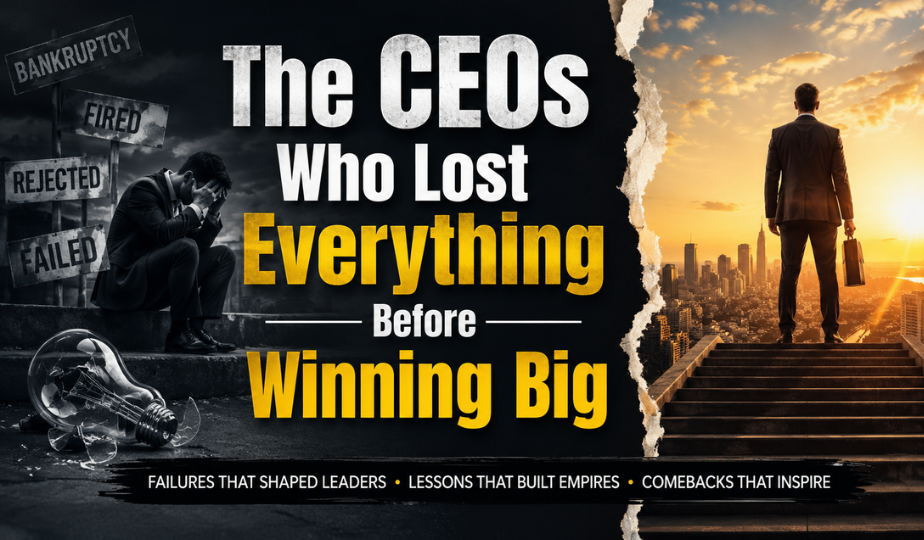
Success is often presented as a straight line, but the journeys of many successful CEOs tell a very different story. Before building billion-dollar companies, leading global brands, or becoming respected business leaders, some executives experienced bankruptcy, failed businesses, career setbacks, rejected ideas, or major financial losses.
Their stories offer an important lesson: failure does not always mark the end of a career. In many cases, it becomes a turning point that teaches resilience, discipline, and better decision-making.
Who Are the CEOs Who Lost Everything Before Becoming Successful?
Several well-known business leaders experienced serious setbacks before achieving major success. Their failures included unsuccessful companies, financial difficulties, rejected business ideas, and periods when their careers appeared to be moving backward.
These experiences helped them understand markets, customers, leadership, and risk in ways that success alone could not teach.
Did Failure Help These CEOs Become Better Leaders?
Yes. Failure can expose weaknesses that success often hides.
When a business fails, an entrepreneur may discover that the product is wrong, the market is too small, costs are too high, or the business model is unsustainable. Learning these lessons can help future CEOs make more informed decisions.
For many successful executives, failure created a stronger understanding of risk and responsibility.
Which CEOs Faced Major Business Failures?
Steve Jobs: Removed From the Company He Helped Build
Steve Jobs is one of the most famous examples of a leader who experienced a dramatic professional setback.
After disagreements over Apple’s direction and management, Jobs left the company in 1985. At the time, losing control of the company he had helped create was a major personal and professional blow.
Instead of abandoning entrepreneurship, Jobs founded NeXT and became involved with Pixar. His work during this period expanded his experience in technology and creative industries.
When Apple acquired NeXT in 1997, Jobs returned to Apple. His second chapter at the company eventually became one of the most influential corporate turnarounds in modern business.
What can entrepreneurs learn? A career setback can create space to develop new skills and perspectives.
Walt Disney: Bankruptcy Before Building an Empire
Walt Disney experienced significant financial difficulties during his early career.
One of his early animation ventures failed, contributing to financial problems and eventually bankruptcy. Disney nevertheless continued pursuing animation and storytelling.
He later helped build The Walt Disney Company into one of the world’s most recognizable entertainment businesses.
His story demonstrates that an unsuccessful company does not necessarily define an entrepreneur’s long-term potential.
Arianna Huffington: Rejection Before Media Success
Arianna Huffington faced rejection before becoming a major media entrepreneur.
Her second book was reportedly rejected by multiple publishers, and her early political ambitions also encountered setbacks. These experiences did not stop her from continuing to build a public career.
In 2005, she co-founded The Huffington Post, which became a major digital media platform.
Her journey highlights the importance of continuing to create even when early efforts receive little support.
Reid Hoffman: Learning From an Unsuccessful Startup
LinkedIn co-founder Reid Hoffman experienced an important early entrepreneurial lesson with SocialNet, one of his first startup ventures.
The company did not achieve the success Hoffman expected. Instead of treating the experience as wasted time, he used what he learned to improve his understanding of technology businesses and networks.
That experience contributed to his later work in building LinkedIn.
The lesson: an unsuccessful startup can still provide valuable education for the next business.
Can Losing Money Make an Entrepreneur More Careful?
Why Financial Failure Changes Decision-Making
Financial losses can make entrepreneurs more aware of cash flow, expenses, customer demand, and business sustainability.
A founder who has experienced serious financial pressure may become more disciplined about spending and more cautious about taking unnecessary risks.
However, failure should not be romanticized. Losing money can create real financial and emotional consequences. The useful lesson comes from analyzing what went wrong and applying that knowledge to future decisions.
What Do Failed Businesses Teach Future CEOs?
1. Markets Matter
A strong idea is not enough. Customers must actually want the product or service.
Successful CEOs often learn to test demand before investing significant resources.
2. Cash Flow Is Critical
Revenue, expenses, debt, and cash reserves can determine whether a company survives.
Understanding financial fundamentals is one of the most important skills for entrepreneurs.
3. Leadership Requires Adaptability
Business conditions change quickly. CEOs must be willing to adjust strategies when evidence shows that an original plan is not working.
4. Rejection Is Not Always a Final Answer
Investors, publishers, customers, and business partners may reject an idea for many reasons.
A rejection can sometimes reveal weaknesses that need to be addressed—or simply mean the timing is wrong.
Why Do Some Entrepreneurs Recover While Others Give Up?
The difference is often resilience combined with reflection.
Resilience means continuing after a setback, but persistence alone is not enough. Entrepreneurs also need to understand why they failed.
Successful recovery often involves asking:
- What went wrong?
- What was under my control?
- What did customers tell me?
- Which assumptions were incorrect?
- What should I do differently next time?
This turns failure into practical knowledge.
Is Failure Necessary for CEO Success?
No. Failure is not a requirement for becoming a successful CEO.
Some entrepreneurs build successful companies without experiencing catastrophic losses. However, difficult experiences can develop qualities that are valuable in leadership, including patience, adaptability, financial discipline, and emotional resilience.
The important point is not to fail deliberately. It is to learn effectively when failure happens.
What Can Young Entrepreneurs Learn From Failed CEOs?
Young entrepreneurs can learn that successful careers rarely develop exactly as planned.
A failed product does not automatically mean a failed entrepreneur. A rejected proposal does not necessarily mean a bad idea. Losing a job does not mean the end of a career.
Instead, setbacks can become opportunities to reconsider strategy, develop expertise, and discover better opportunities.
How Can Entrepreneurs Turn Failure Into Success?
Study the Failure Honestly
Avoid blaming only external factors. Examine the decisions, assumptions, financial choices, and leadership mistakes that contributed to the outcome.
Protect the Next Opportunity
Do not repeat the same mistake simply because of emotional attachment to an idea.
Build Better Systems
Use lessons from failure to improve hiring, budgeting, product development, customer research, and decision-making.
Stay Open to Reinvention
Sometimes the next successful business looks completely different from the first one.
What Is the Biggest Lesson From CEOs Who Lost Everything?
The biggest lesson is that failure and success are not always opposites. Sometimes they are different stages of the same entrepreneurial journey.
The CEOs who eventually achieved extraordinary results were not successful because they avoided every setback. Many became stronger because they learned how to respond when things went wrong.
Their experiences show that losing a company, facing rejection, experiencing financial difficulties, or suffering a major career setback can become a powerful learning experience.
For today’s entrepreneurs, the message is straightforward: failure can change your direction, but it does not have to determine your destination.
Frequently Asked Questions
Who is the best example of a CEO who recovered from failure?
Steve Jobs is one of the most recognizable examples. After leaving Apple, he continued building companies and eventually returned to help lead Apple’s transformation.
Can a failed startup lead to future success?
Yes. A failed startup can teach founders about customers, technology, finances, hiring, and business models. Those lessons can improve future ventures.
Does failure make entrepreneurs stronger?
Failure can make entrepreneurs more resilient and disciplined when they analyze what happened and apply the lessons to future decisions.
Should entrepreneurs be afraid of failure?
Entrepreneurs should take failure seriously but should not allow fear of failure to prevent thoughtful experimentation. Good planning, financial discipline, and market research can reduce unnecessary risks.
What should a CEO do after a major business failure?
A CEO should assess the causes of failure, protect remaining resources, learn from customers and stakeholders, and decide whether to rebuild, pivot, or pursue a new opportunity.
Final Thoughts
The stories of CEOs who struggled before succeeding provide a more realistic view of entrepreneurship. Behind many impressive companies are years of uncertainty, rejection, mistakes, and difficult decisions.
The defining factor is often what leaders do next.
Failure may close one chapter, but with reflection, adaptability, and determination, it can also open the door to a much better one.
Also Read:-
Gulf CEOs Shaping the Region’s Innovation Economy
Dubai’s New Business Titans Building Future Unicorns
Visionary CEOs Building Global Brands from Small Beginnings