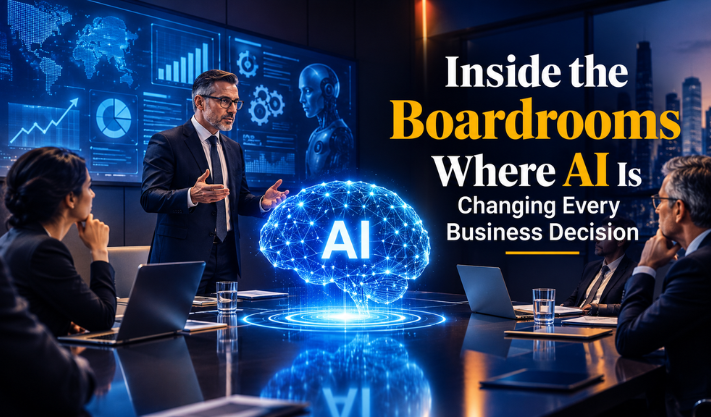
Artificial intelligence is no longer something businesses discuss only in technology departments. It has moved into executive meetings, strategy sessions, financial reviews, hiring discussions, marketing plans, and product development. Across industries, leaders are using AI to understand data faster, identify risks, predict customer behavior, and make more informed decisions.
But what does AI actually change inside the boardroom? And how is it reshaping the way companies think about growth, competition, employees, and customers?
What Role Does AI Play in Modern Business Decision-Making?
AI helps business leaders turn large amounts of information into actionable insights. Instead of relying only on historical reports and manual analysis, executives can use AI systems to identify patterns, compare scenarios, and generate forecasts.
For example, an executive team considering a new market can use AI to analyze customer demand, competitors, pricing trends, economic indicators, and operational costs. This does not eliminate human decision-making. Instead, it gives leaders more information before making a strategic choice.
The biggest change is speed. Decisions that once required days or weeks of analysis can increasingly begin with insights generated within minutes.
How Is AI Changing the CEO’s Role?
AI is changing the CEO’s role from simply reviewing information to asking better questions about it.
Executives can use AI to explore different scenarios before committing resources. A CEO might ask what could happen if customer demand falls by 10%, supply costs increase, or a competitor launches a cheaper product.
This creates a more dynamic approach to leadership. Instead of preparing one forecast, companies can examine multiple possible futures.
However, CEOs still need judgment. AI can identify patterns, but leadership requires understanding people, organizational culture, ethics, and long-term consequences.
How Is AI Influencing Financial Decisions?
Finance is one of the areas where AI can have a major impact.
Companies can use AI to examine cash flow, expenses, sales forecasts, market conditions, and financial risks. AI-powered systems can also identify unusual transactions and support fraud detection.
For board members and financial executives, this means financial discussions can become more data-driven. Instead of asking only what happened last quarter, leaders can also ask why it happened and what could happen next.
AI can support budgeting, investment analysis, demand forecasting, and scenario planning. Still, financial decisions require human oversight because predictions are based on available data and assumptions that can change.
Can AI Improve Marketing and Customer Decisions?
Yes. AI is transforming how companies understand their customers.
Businesses can analyze purchasing behavior, customer feedback, website activity, and engagement patterns to identify changing preferences. Marketing teams can then use those insights to create more relevant campaigns and improve customer experiences.
For boardrooms, this means customer strategy can become more measurable. Leaders can examine which products are gaining attention, which audiences are changing, and where customers are leaving the purchasing journey.
AI can also help companies personalize communications at scale. The challenge is ensuring that personalization remains useful rather than intrusive.
How Is AI Changing Hiring and Workforce Strategy?
AI is also influencing decisions about people.
Executives can use data to understand workforce needs, identify skills gaps, forecast hiring requirements, and evaluate organizational capacity. AI tools can assist with administrative recruitment tasks and help employees find relevant learning opportunities.
But workforce decisions require particular caution. Algorithms can reproduce biases contained in historical data. A system that appears objective can still produce unfair outcomes if its underlying data or design is flawed.
For this reason, human review remains essential when AI is used in recruitment, performance evaluation, promotions, or other sensitive employment decisions.
Why Are Board Members Paying More Attention to AI Risk?
The opportunities created by AI come with significant risks.
Boardrooms increasingly need to discuss data privacy, cybersecurity, intellectual property, regulatory requirements, inaccurate AI-generated information, and reputational damage.
There is also the question of accountability. If an AI-assisted recommendation contributes to a poor business decision, executives need to understand who is responsible for reviewing and approving that recommendation.
Strong AI governance therefore becomes a business issue, not simply an IT issue.
Is AI Replacing Human Decision-Makers?
AI is more accurately viewed as a decision-support technology than a complete replacement for executives.
AI can process information quickly, identify patterns, generate scenarios, and automate repetitive analysis. Humans provide context, values, accountability, creativity, and strategic judgment.
The strongest organizations are likely to combine both capabilities. AI can answer questions about data, while leaders determine what those answers mean for the company’s mission and stakeholders.
The goal is not to create a boardroom without humans. It is to create a boardroom where humans can make better-informed decisions.
How Does AI Affect Business Strategy?
AI is changing strategy by making experimentation and scenario planning easier.
A company can test different assumptions, examine potential outcomes, and identify vulnerabilities before taking action. This can make strategic planning more flexible.
AI can also reveal opportunities that executives might overlook when working with traditional reports. Patterns across large datasets may expose emerging customer needs, operational inefficiencies, or potential markets.
However, companies should avoid treating every AI-generated insight as a strategic truth. A prediction is only as reliable as the data, methodology, and assumptions behind it.
What Industries Are Being Most Affected by AI?
Almost every major industry is being influenced by AI.
Healthcare: AI can support research, administrative processes, diagnostics, and patient-care workflows.
Finance: Banks and financial institutions use AI for fraud detection, risk analysis, customer service, and forecasting.
Retail: Businesses use AI to understand demand, personalize experiences, optimize inventory, and improve pricing strategies.
Manufacturing: AI can support predictive maintenance, quality control, supply-chain planning, and production optimization.
Technology: AI is accelerating software development, cybersecurity, automation, and product innovation.
Professional services: Consulting, legal, accounting, and other knowledge-based industries are exploring AI for research, analysis, documentation, and workflow automation.
The specific applications differ, but the underlying shift is similar: organizations are using intelligent systems to process information and support decisions faster.
What Should Companies Do Before Using AI at the Board Level?
Companies should begin with clear business objectives rather than adopting AI simply because it is popular.
Executives should identify which decisions could benefit from better data, faster analysis, or improved forecasting. They should then evaluate the quality of available data, security requirements, regulatory considerations, and potential risks.
Clear governance is equally important. Companies should define who can use AI, what information can be entered into AI systems, which decisions require human approval, and how AI-generated recommendations should be evaluated.
Training is also critical. Executives and employees need to understand both the capabilities and limitations of AI.
What Does the AI-Powered Boardroom of the Future Look Like?
The future boardroom will likely be more data-driven, faster, and more focused on scenario-based thinking.
Executives may arrive at meetings with AI-generated forecasts, risk assessments, customer insights, and competitive analysis already prepared. Instead of spending most of the meeting reviewing basic information, leaders can spend more time debating strategy and deciding what actions to take.
AI may become a standard layer of business intelligence, operating quietly behind financial planning, customer strategy, operations, and risk management.
Yet the most successful organizations will not be those that simply use the most AI. They will be those that know where AI should be trusted, where it should be questioned, and where human judgment must remain in control.
Final Takeaway: Who Makes the Final Business Decision?
AI is changing how businesses gather information, analyze possibilities, and prepare for the future. It is becoming an important participant in strategic discussions across the modern enterprise.
But AI does not carry the same responsibility as a human executive or board.
The future of business decision-making is therefore unlikely to be AI versus humans. It will be AI plus human judgment.
Also Read:-
Second-Time Founders Who Built Billion-Dollar Businesses
Business Leaders Who Turned Failure Into Investment
Beyond Oil: CEOs Transforming the Middle East’s Digital Economy