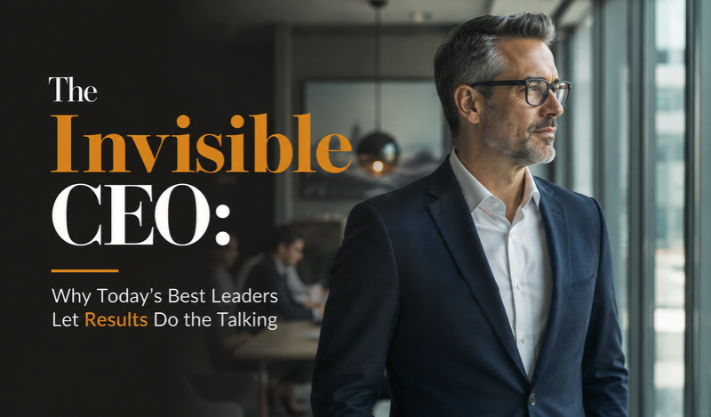
Leadership is changing. The traditional image of a CEO as the loudest person in the room, constantly appearing in the media and making bold declarations, is giving way to a quieter and more effective model. Today’s strongest leaders often do not need to constantly promote themselves. Instead, they build capable teams, make smart decisions, create measurable value, and allow their results to speak for them.
But what exactly is an “invisible CEO,” and why is this leadership style becoming increasingly powerful?
What Is an Invisible CEO?
An invisible CEO is a business leader who focuses more on execution, people, strategy, and outcomes than personal visibility.
This does not mean the CEO is absent or disconnected. Quite the opposite. Invisible CEOs are deeply involved in the direction of their organizations, but they do not feel the need to make themselves the center of every success.
Their philosophy is simple: lead effectively, communicate clearly, and let performance create the reputation.
Instead of asking, “How can I become more visible?” these leaders often ask, “How can I make my organization more successful?”
Why Are Quiet Leaders Becoming More Effective?
Modern business moves quickly. Customers are better informed, employees expect authenticity, and investors increasingly look beyond polished personal branding.
In this environment, excessive self-promotion can create a credibility gap.
A CEO who constantly talks about innovation but fails to deliver may quickly lose trust. By contrast, a leader who quietly improves operations, develops talent, increases customer satisfaction, and produces sustainable growth creates credibility through evidence.
Results are difficult to argue with.
A successful product launch, stronger employee retention, expanding market share, improved profitability, or loyal customers can communicate more effectively than dozens of interviews.
Do Invisible CEOs Avoid Communication?
No. Being low-profile does not mean being silent.
Effective invisible CEOs communicate when communication matters. They explain strategy, establish expectations, address challenges, recognize employees, and speak publicly when their organizations need a clear voice.
The difference is purpose.
Instead of communicating simply to remain visible, they communicate to create clarity, confidence, and alignment.
This distinction is especially important in times of uncertainty. Employees do not necessarily need a CEO who speaks constantly. They need a leader who can provide honest answers and a clear direction when it matters most.
How Do Invisible CEOs Build Trust?
Trust is built through consistency.
Employees and stakeholders tend to trust leaders whose actions match their words. An invisible CEO therefore focuses heavily on keeping commitments, making fair decisions, accepting responsibility, and maintaining consistent standards.
They also give credit to others.
Rather than taking personal ownership of every achievement, strong leaders recognize the teams behind the results. This creates a culture where employees feel valued and motivated to contribute.
Over time, this approach can create something more powerful than personal popularity: organizational credibility.
What Makes Results More Powerful Than Personal Branding?
Personal branding can attract attention, but results create lasting authority.
A CEO may have millions of social media impressions, frequent media appearances, and a recognizable personal brand. But if the business is struggling, visibility alone does not create meaningful leadership credibility.
Results provide measurable evidence.
Revenue growth, successful expansion, innovative products, operational efficiency, customer loyalty, employee development, and sustainable profitability demonstrate whether leadership decisions are actually working.
The strongest CEOs understand that reputation should follow performance—not replace it.
How Do Invisible CEOs Lead Their Teams?
One of the defining characteristics of quiet leadership is the ability to empower others.
An effective CEO does not try to make every decision personally. Instead, they build strong leadership teams and give capable people enough authority to act.
This requires hiring well, setting clear objectives, establishing accountability, and creating an environment where employees can make decisions without constantly waiting for executive approval.
When teams become stronger, the CEO becomes less visible in day-to-day operations—but the organization becomes more capable.
That is not weakness. It is successful leadership design.
Why Is Humility Important for Modern CEOs?
Humility allows leaders to remain open to information.
A CEO who believes they always have the best answer can become isolated from employees, customers, and market realities. A humble leader is more willing to listen, ask questions, change direction, and admit mistakes.
This does not mean lacking confidence.
Healthy leadership combines confidence with curiosity. The leader can have a strong vision while still recognizing that valuable ideas can come from anywhere within the organization.
In rapidly changing industries, that mindset can become a competitive advantage.
Can an Invisible CEO Still Have a Strong Personal Brand?
Absolutely.
Being invisible does not mean being unknown. It means that personal visibility is not the primary objective.
An effective CEO can maintain a respected professional reputation through thoughtful interviews, industry contributions, speaking engagements, or social media while keeping the focus on ideas, customers, employees, and business achievements.
The goal is not to disappear. The goal is to avoid making personal attention more important than organizational performance.
What Can Entrepreneurs Learn From Invisible CEOs?
Entrepreneurs can learn that leadership is ultimately about building something that works without requiring constant personal intervention.
Three lessons stand out.
First, build systems instead of dependency. A company should not collapse whenever its founder steps away.
Second, develop people. The strongest organizations are filled with capable individuals who can make decisions and solve problems.
Third, measure outcomes. Growth, customer satisfaction, profitability, innovation, and employee performance provide a clearer picture of leadership effectiveness than popularity alone.
Entrepreneurs who adopt these principles can build businesses with greater resilience and long-term value.
Is Quiet Leadership the Future of Business?
Quiet leadership is unlikely to replace every traditional leadership style, but it is becoming increasingly relevant.
The modern CEO operates in an environment where transparency is high and reputation can change quickly. Employees can share workplace experiences publicly, customers can instantly review products, and investors can examine business performance from multiple angles.
In such an environment, authenticity matters.
Leaders cannot rely solely on appearances. Their organizations must deliver.
That makes the ability to create sustainable results increasingly important.
What Is the Biggest Lesson From the Invisible CEO?
The biggest lesson is simple: leadership does not have to be loud to be powerful.
The best CEOs understand when to step forward and when to step back. They know when their voice is necessary and when their teams should take the lead.
They focus on building businesses that deliver value, cultures that develop people, and strategies that produce measurable outcomes.
Eventually, those achievements become their strongest introduction.
The invisible CEO is therefore not a leader who avoids responsibility or visibility. It is a leader who understands that attention is temporary, while meaningful results can create lasting influence.
Also Read:-
The Human Edge: Why CEOs Still Outlead AI
How AI Is Creating a New Generation of CEOs
The CEO Influencer Era: Leadership as a Personal Brand