The startup world has long celebrated venture capital as a powerful engine for growth. Funding can provide access to talent, technology, marketing, and global expansion. Yet a different model is quietly proving that startups do not always need millions in outside investment to compete.
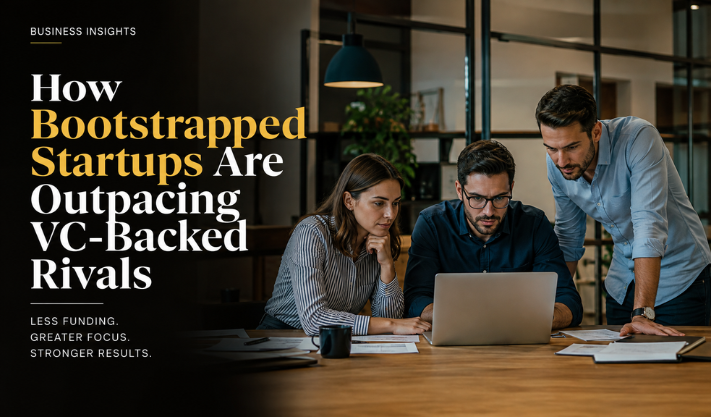
Bootstrapped startups—companies funded primarily through founders’ savings, early revenue, and internally generated cash flow—are increasingly demonstrating that disciplined growth can outperform heavily funded competitors. By focusing on profitability, customer needs, and efficient operations, these companies can build durable businesses without the pressure that often accompanies venture-backed growth.
What Is a Bootstrapped Startup?
A bootstrapped startup is a company that grows without relying heavily on external investors. Instead, founders typically use personal savings, revenue from customers, reinvested profits, or other internally generated resources to finance operations.
The model encourages founders to prioritize cash flow, customer retention, profitability, and sustainable expansion from the beginning.
VC-backed companies, by comparison, often raise capital to accelerate growth before reaching profitability. This can help them scale quickly, but it can also create expectations around rapid expansion and future returns.
Why Are Bootstrapped Startups Becoming More Competitive?
One major reason is changing technology.
Cloud computing, artificial intelligence, no-code platforms, remote work, digital marketing, and online distribution have dramatically reduced the cost of launching and operating many businesses.
A startup can now reach customers globally without necessarily building a large office, hiring hundreds of employees, or investing heavily in physical infrastructure.
This gives bootstrapped founders an important advantage: they can operate with less capital while still accessing sophisticated tools.
Do Bootstrapped Startups Grow More Slowly?
Not necessarily.
Bootstrapping can initially require slower and more deliberate growth, but that does not mean the company will remain small.
Many founders now prioritize efficient growth rather than growth at any cost. Instead of spending aggressively to acquire customers, they may focus on organic marketing, referrals, partnerships, customer retention, and products that generate recurring revenue.
The result can be a business that grows steadily while maintaining healthier economics.
In today’s startup environment, efficient growth can be more valuable than headline growth.
How Does Profitability Give Bootstrapped Companies an Advantage?
Profitability provides independence.
A profitable startup does not necessarily need to raise another funding round simply to keep operating. It can use its own revenue to hire employees, improve products, expand into new markets, and invest in marketing.
This creates greater strategic flexibility.
VC-backed startups may have substantial financial resources, but they also face investor expectations. They may need to demonstrate increasingly ambitious growth, raise additional capital, or pursue an exit strategy.
Bootstrapped companies can make decisions based primarily on what benefits the business and its customers over the long term.
Why Can Bootstrapped Founders Make Faster Decisions?
Ownership structure matters.
When a startup has several investors, major decisions can involve boards, shareholders, executives, and other stakeholders. A bootstrapped founder may have a much simpler decision-making structure.
This can make it easier to:
- Change product direction
- Adjust pricing
- Enter or leave a market
- Experiment with new business models
- Reduce unnecessary spending
- Respond quickly to customer feedback
Speed does not automatically guarantee success, but in competitive markets, the ability to react quickly can become a significant advantage.
Does Bootstrapping Improve Customer Focus?
It can.
When every customer contributes directly to revenue, customer satisfaction becomes closely connected to the company’s survival and growth.
Bootstrapped businesses therefore often concentrate heavily on solving specific customer problems.
Instead of asking, “How can we grow users as quickly as possible?”, the question becomes:
“How can we create enough value that customers are willing to pay, stay, and recommend us?”
That difference can produce stronger customer relationships and more sustainable revenue.
Why Is Capital Efficiency Becoming More Important?
The startup landscape has changed.
During periods of abundant venture capital, startups could sometimes prioritize market share and rapid expansion ahead of profitability. However, tighter funding conditions have encouraged founders and investors to pay closer attention to business fundamentals.
Key metrics such as:
- Customer acquisition cost
- Lifetime customer value
- Gross margins
- Monthly recurring revenue
- Cash flow
- Retention
- Payback periods
have become increasingly important.
Bootstrapped companies are often forced to understand these numbers early because they cannot depend on large funding rounds to cover inefficient operations.
Can Bootstrapped Startups Outperform VC-Backed Companies?
Yes, under the right circumstances.
Outperformance does not necessarily mean generating more revenue or becoming larger than a VC-backed competitor. It can mean achieving better profitability, stronger customer retention, greater capital efficiency, or more sustainable long-term growth.
A bootstrapped company generating $5 million in highly profitable annual revenue may be strategically healthier than a heavily funded competitor generating significantly more revenue while losing substantial amounts of money.
The key metric is not always size. Business quality matters.
What Role Does AI Play in the Rise of Bootstrapped Startups?
Artificial intelligence is potentially one of the biggest accelerators for capital-efficient entrepreneurship.
AI tools can help small teams automate repetitive work across customer support, marketing, research, coding, analytics, content creation, and administrative operations.
This means a startup with a handful of employees can potentially accomplish work that previously required much larger teams.
However, AI does not eliminate the need for strong strategy. The advantage comes from combining technology with clear customer problems, strong execution, and disciplined financial management.
Are Bootstrapped Startups Better for Founders?
For many entrepreneurs, they can be.
Bootstrapping allows founders to retain greater ownership and control. They may not have to surrender significant equity to investors or build the company around a predetermined exit timeline.
That freedom can be especially valuable for founders who want to create a sustainable company rather than maximize short-term valuation.
However, bootstrapping also involves greater personal financial risk. Founders may have fewer resources, slower access to talent, and less room for expensive experimentation.
When Should a Startup Choose Venture Capital Instead?
Bootstrapping is not the right model for every company.
Some businesses require substantial upfront investment. Biotechnology, advanced hardware, semiconductor development, deep infrastructure, and certain marketplaces may need significant capital before meaningful revenue can be generated.
In these cases, venture capital can provide the resources necessary to develop products and compete effectively.
The best funding strategy depends on the business model, market opportunity, capital requirements, and founder objectives.
What Is the Future of Bootstrapped Entrepreneurship?
The future is likely to include more diverse startup funding models.
Entrepreneurs no longer have to choose between traditional venture capital and staying extremely small. They can combine revenue-based financing, strategic partnerships, grants, crowdfunding, angel investment, or selective institutional funding with organic growth.
Technology is also making entrepreneurship more accessible.
As operating costs decline and digital distribution expands, a small team can build a global business with significantly fewer resources than previous generations required.
FAQ: Bootstrapped Startups vs. VC-Backed Startups
Are bootstrapped startups more profitable?
They can be, because founders typically prioritize revenue and cash flow from the beginning. However, profitability depends on the company’s business model and execution.
Why do founders choose bootstrapping?
Common reasons include maintaining ownership, avoiding investor pressure, controlling strategic decisions, and building a business around sustainable revenue.
Can a bootstrapped startup become a large company?
Absolutely. Bootstrapping does not place a permanent limit on company size. Successful businesses can reinvest revenue and expand gradually into larger markets.
Is venture capital bad for startups?
No. Venture capital can be extremely valuable when a company needs significant capital to capture a large market quickly. The issue is whether the funding model matches the company’s needs.
What is the biggest advantage of bootstrapping?
Financial and strategic independence. Founders can often focus on customers and long-term business health rather than meeting external growth or fundraising expectations.
Why are bootstrapped startups attracting attention now?
Lower technology costs, AI-powered productivity, changing investor expectations, and greater emphasis on profitability have made capital-efficient businesses increasingly attractive.
Conclusion
The startup success story is no longer defined exclusively by how much money a company raises.
Bootstrapped startups are demonstrating that disciplined execution, customer loyalty, profitability, and capital efficiency can be powerful competitive advantages. With AI and digital tools reducing the cost of building businesses, smaller teams can compete in markets that once demanded enormous amounts of capital.
Also Read:-
Risk-Takers Reshaping the Future of Global Entrepreneurship
AI-Native Startups Are Disrupting Traditional Industries
What Fast-Growing CEOs Do Differently Every Morning