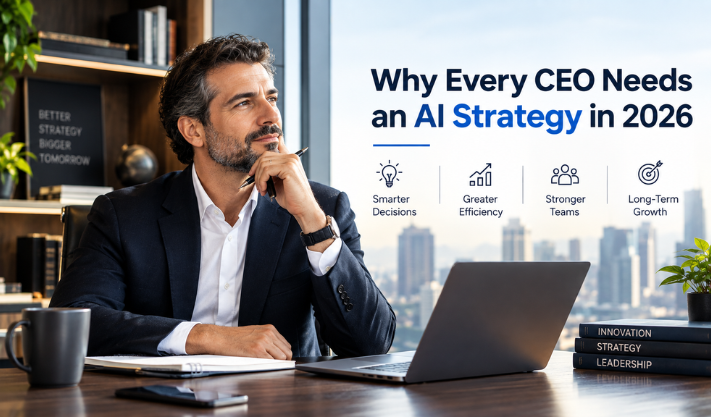
Artificial intelligence is no longer simply a technology initiative reserved for IT departments. In 2026, AI has become a strategic business priority that can influence growth, customer experience, productivity, innovation, risk management, and competitive advantage.
For CEOs, the question is no longer whether their company should use AI. The more important question is how AI should be integrated into the organization’s long-term strategy. A well-designed AI strategy can help businesses make faster decisions, automate repetitive work, understand customers better, and identify new opportunities.
Here are the key questions every CEO should consider when building an AI strategy in 2026.
What is an AI strategy?
An AI strategy is a structured business plan for using artificial intelligence to achieve specific organizational goals.
It goes beyond purchasing AI software. A strong strategy identifies where AI can create measurable value, what data and infrastructure are required, how employees will use AI, what risks need to be controlled, and how success will be measured.
For CEOs, AI strategy should connect directly with broader business objectives rather than operate as an isolated technology project.
Why does every CEO need an AI strategy in 2026?
Every CEO needs an AI strategy because AI is changing how companies compete and operate.
Businesses are increasingly using AI for customer service, marketing, sales forecasting, financial analysis, product development, cybersecurity, recruitment, research, and internal operations. Companies that develop a thoughtful AI strategy can potentially improve efficiency while creating new products and revenue opportunities.
Without a strategy, organizations may adopt disconnected AI tools, waste resources, create security risks, or fall behind competitors that are integrating AI more effectively.
How can AI help a business grow?
AI can support business growth by helping companies understand markets, customers, and operations more effectively.
For example, AI can analyze large volumes of business data, identify customer trends, personalize marketing, improve sales forecasting, and support faster product development.
AI can also help smaller organizations compete by giving employees access to capabilities that previously required larger teams or significant resources.
However, growth does not come from AI alone. CEOs need to identify specific business problems where AI can produce measurable improvements.
Can AI improve CEO decision-making?
Yes. AI can become an important decision-support tool for executives.
Modern AI systems can analyze large amounts of information, summarize complex reports, identify patterns, generate scenarios, and provide insights that help leaders evaluate options.
However, CEOs should treat AI as a decision-support system rather than an unquestionable authority. Human judgment remains essential, particularly for decisions involving people, finances, ethics, reputation, and long-term strategy.
The best approach combines AI-generated insights with executive experience and critical thinking.
How can CEOs use AI to improve productivity?
One of the most immediate benefits of AI is productivity.
AI can automate repetitive administrative tasks such as drafting documents, summarizing meetings, analyzing information, organizing knowledge, assisting with customer inquiries, and creating initial versions of business content.
This allows employees to spend more time on activities requiring creativity, communication, problem-solving, and strategic thinking.
For CEOs, the goal should not simply be to reduce the amount of human work. Instead, AI should help employees spend more of their time on higher-value work.
Does an AI strategy require replacing employees?
No. An effective AI strategy does not necessarily mean replacing employees.
In many organizations, AI is more valuable as an augmentation tool that helps employees work faster and make better-informed decisions.
The future workplace is likely to involve greater collaboration between people and AI systems. Employees may use AI as a research assistant, writing partner, analyst, coding assistant, customer-service support tool, or productivity platform.
CEOs should therefore focus on developing AI skills across the workforce while redesigning processes where automation genuinely creates value.
Why is data important to an AI strategy?
Data is one of the most important foundations of successful AI adoption.
AI systems depend on useful, accurate, relevant, and properly governed data. If business data is incomplete, outdated, poorly organized, or inaccessible, AI initiatives may produce unreliable results.
CEOs should therefore consider data quality, privacy, security, ownership, accessibility, and governance when developing an AI strategy.
A company with strong data foundations can generally make better use of AI than an organization that simply purchases advanced AI tools without addressing its underlying information systems.
What are the biggest AI risks for businesses?
AI creates opportunities, but it also introduces risks.
These can include inaccurate AI-generated information, data privacy problems, cybersecurity threats, intellectual property concerns, regulatory challenges, biased outputs, and excessive dependence on automated systems.
CEOs should establish clear policies covering how employees can use AI, what information can be entered into AI tools, how outputs should be reviewed, and who is responsible for AI-related decisions.
Responsible AI governance should be considered part of business strategy, not an afterthought.
How should a CEO begin building an AI strategy?
The best starting point is to identify business problems rather than start with technology.
CEOs can ask several practical questions:
- Which business processes consume significant time?
- Where are employees facing repetitive work?
- What customer problems could AI help solve?
- Which decisions could benefit from better data analysis?
- Where could automation reduce operational costs?
- Could AI create a new product, service, or revenue stream?
After identifying opportunities, leadership teams can prioritize AI projects based on potential business impact, implementation difficulty, cost, and risk.
Starting with a small number of high-value projects can be more effective than attempting an organization-wide transformation immediately.
Should every company build its own AI system?
No. Most companies do not need to build an AI model from scratch.
Businesses can use existing AI platforms, specialized enterprise tools, industry-specific applications, or customized solutions depending on their requirements.
The right choice depends on factors such as business objectives, data sensitivity, budget, technical capabilities, and the level of customization required.
CEOs should focus on the business outcome first and choose technology that supports that outcome.
What skills do employees need in an AI-driven workplace?
Employees increasingly need a combination of traditional professional expertise and AI literacy.
AI literacy includes understanding how to use AI tools effectively, evaluate their outputs, recognize limitations, protect sensitive information, and apply human judgment.
Leadership teams should also develop stronger capabilities in AI governance, data management, cybersecurity, technology evaluation, and change management.
Continuous learning will become increasingly important as AI technologies evolve.
How can CEOs measure the success of an AI strategy?
AI initiatives should be measured through business outcomes rather than excitement around the technology.
Useful metrics can include productivity gains, reduced operating costs, faster processes, improved customer satisfaction, higher revenue, better forecasting accuracy, employee adoption, and improved product development.
Every major AI project should have a clear objective and measurable key performance indicators.
If an AI initiative cannot demonstrate meaningful business value, leadership should reconsider whether it deserves additional investment.
What will separate successful AI companies from unsuccessful ones?
The biggest difference will likely be strategic execution.
Successful companies will not necessarily be those using the largest number of AI tools. They will be organizations that understand where AI creates genuine value and integrate it into their people, processes, data, and business models.
CEOs who treat AI as a temporary trend may struggle to keep pace. Leaders who approach it as a long-term strategic capability can position their organizations to adapt more effectively.
What is the future of AI strategy for CEOs?
AI strategy will increasingly become part of overall corporate strategy.
As AI becomes embedded into everyday business operations, CEOs will need to think about AI alongside finance, marketing, operations, talent, innovation, cybersecurity, and customer experience.
The most important leadership skill may not be knowing how every AI system works. Instead, CEOs need to understand what AI can accomplish, where it creates value, what risks it introduces, and how to build an organization capable of adapting to continuous technological change.
Final Thoughts
In 2026, an AI strategy is becoming a fundamental part of modern business leadership. AI can help companies improve productivity, strengthen decision-making, personalize customer experiences, automate processes, and discover new opportunities.
But technology alone does not create competitive advantage. The real advantage comes from using AI strategically, responsibly, and with a clear understanding of business objectives.
For CEOs, the next step is simple: identify where AI can solve meaningful problems, invest in the right capabilities, prepare employees for change, establish responsible governance, and continuously measure results.
Also Read:-
Tech Innovations Redefining Modern Entrepreneurship Today
Bootstrapped Startups Are Outpacing VC-Backed Rivals
Risk-Takers Reshaping the Future of Global Entrepreneurship