Table of Contents
ToggleA New Era of Healthcare Innovation
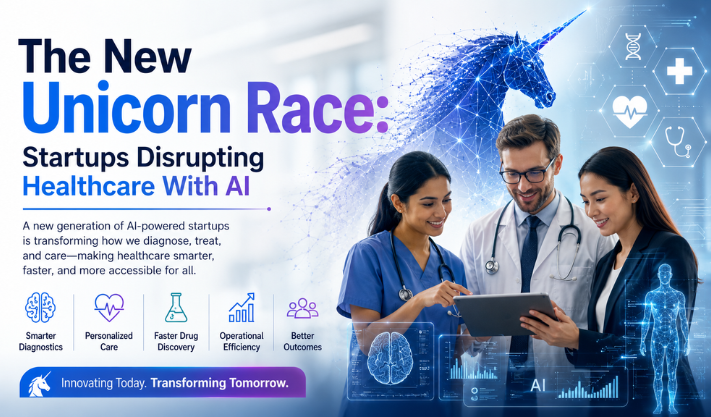
The healthcare industry is experiencing one of the most significant transformations in its history, driven by the rapid advancement of artificial intelligence (AI). What was once considered a futuristic concept is now becoming an essential part of modern medicine, helping healthcare providers diagnose diseases faster, personalize treatments, streamline administrative tasks, and improve patient outcomes. As investors pour billions of dollars into health-tech ventures, a new race has emerged—the race to build the next healthcare unicorn. These startups are leveraging AI to tackle some of the industry’s most pressing challenges, from physician shortages and rising healthcare costs to delayed diagnoses and inefficient workflows. Unlike previous waves of healthcare innovation that focused primarily on digital record-keeping or telemedicine, today’s AI-driven startups are fundamentally reimagining how healthcare is delivered, making medical services more accessible, accurate, and efficient.
Why Healthcare Is Ready for AI Disruption
Healthcare generates enormous amounts of data every day, including medical records, diagnostic images, laboratory reports, clinical notes, and patient-generated information from wearable devices. Traditionally, much of this data remained underutilized because analyzing it required extensive human effort. AI changes this equation by processing vast datasets in seconds and identifying patterns that might otherwise go unnoticed. This capability allows healthcare professionals to make better-informed decisions while reducing administrative burdens. The timing is also ideal for disruption. Aging populations, increasing rates of chronic diseases, and mounting pressure on healthcare systems worldwide have created a strong demand for scalable solutions. AI startups are stepping in to fill these gaps, offering tools that help clinicians work smarter rather than harder. As healthcare providers seek ways to improve efficiency without compromising quality, AI-powered platforms are becoming increasingly attractive investments.
Transforming Diagnostics Through Machine Learning
One of the most promising areas for AI innovation is medical diagnostics. Startups are developing machine-learning algorithms capable of analyzing medical images such as X-rays, CT scans, MRIs, and pathology slides with remarkable accuracy. These systems can identify abnormalities, detect diseases at earlier stages, and assist radiologists in prioritizing urgent cases. Early diagnosis often leads to better treatment outcomes, making this technology particularly valuable in fields such as oncology, cardiology, and neurology. AI-driven diagnostic tools are also helping address shortages of specialized medical professionals in underserved regions. By providing decision-support capabilities, these platforms enable healthcare providers to deliver higher-quality care even when expert resources are limited. As regulatory approvals increase and clinical validation studies continue to demonstrate effectiveness, diagnostic AI startups are attracting substantial funding and rapidly expanding their market presence.
Revolutionizing Drug Discovery and Development
Drug development has historically been a lengthy and expensive process, often taking more than a decade and billions of dollars to bring a new treatment to market. AI startups are working to dramatically accelerate this timeline. By analyzing biological data, scientific literature, and molecular interactions, AI systems can identify promising drug candidates much faster than traditional research methods. These technologies help researchers predict which compounds are most likely to succeed, reducing costly trial-and-error experimentation. Some startups are also using generative AI to design entirely new molecules tailored to specific diseases. This approach has the potential to unlock treatments for conditions that have long eluded conventional pharmaceutical research. Investors recognize the transformative potential of AI-powered drug discovery, leading to increased partnerships between startups, pharmaceutical companies, and research institutions. The result is a growing ecosystem focused on bringing innovative therapies to patients more quickly and efficiently.
Personalized Medicine Becomes Reality
For decades, healthcare has largely relied on standardized treatment approaches that may not account for individual differences among patients. AI is helping shift the industry toward personalized medicine, where treatments are customized based on a person’s genetics, lifestyle, medical history, and other factors. Startups are creating platforms that analyze complex datasets to recommend therapies most likely to be effective for specific individuals. This personalized approach can improve outcomes while reducing unnecessary treatments and adverse side effects. In cancer care, for example, AI systems can help identify genetic mutations and recommend targeted therapies. In chronic disease management, predictive models can anticipate complications before they occur, enabling proactive interventions. As precision medicine continues to gain traction, startups specializing in AI-driven personalization are becoming key players in the healthcare innovation landscape.
Enhancing Patient Care and Engagement
Beyond clinical decision-making, AI is transforming how patients interact with healthcare systems. Startups are developing intelligent virtual assistants, symptom checkers, and patient engagement platforms that provide guidance and support around the clock. These tools help patients access information, schedule appointments, manage medications, and monitor health conditions without needing constant human intervention. AI-powered chatbots can answer routine questions, reducing pressure on healthcare staff while improving the patient experience. Remote monitoring solutions equipped with AI analytics can detect warning signs and alert providers when intervention is needed. This continuous connection between patients and healthcare professionals helps improve adherence to treatment plans and enables earlier responses to potential health issues. As consumer expectations evolve, startups focused on enhancing patient engagement are finding significant opportunities for growth.
Tackling Administrative Inefficiencies
A substantial portion of healthcare spending is consumed by administrative tasks rather than direct patient care. Physicians often spend hours documenting patient encounters, processing insurance claims, and managing paperwork. AI startups are addressing these inefficiencies through automation technologies that streamline workflows and reduce manual effort. Natural language processing systems can transcribe and summarize clinical conversations, allowing doctors to focus more on patients and less on documentation. Automated billing and coding solutions help minimize errors and accelerate reimbursement processes. Predictive scheduling tools optimize resource allocation and reduce appointment no-shows. By improving operational efficiency, these innovations can lower costs while enhancing productivity across healthcare organizations. Investors see tremendous value in solutions that deliver measurable financial returns, making administrative AI a particularly attractive sector.
Investment Momentum Fuels the Unicorn Race
Venture capital firms, private equity investors, and major technology companies are investing aggressively in healthcare AI startups. The combination of a massive addressable market and clear opportunities for innovation has created intense competition among entrepreneurs seeking to build category-defining businesses. Startups that demonstrate strong clinical outcomes, regulatory compliance, and scalable business models are achieving billion-dollar valuations at an unprecedented pace. The unicorn race is no longer limited to a handful of major technology hubs. Emerging healthcare AI companies are appearing across North America, Europe, Asia, and the Middle East, reflecting the global demand for advanced healthcare solutions. Strategic partnerships with hospitals, insurers, pharmaceutical companies, and government agencies further accelerate growth and market adoption.
Challenges on the Road Ahead
Despite the excitement surrounding healthcare AI, significant challenges remain. Data privacy, regulatory compliance, algorithm transparency, and ethical considerations continue to be critical issues. Healthcare providers must trust that AI systems are accurate, unbiased, and secure before integrating them into clinical workflows. Regulatory agencies are also working to establish frameworks that balance innovation with patient safety. Additionally, startups must navigate complex healthcare ecosystems and demonstrate real-world value beyond technological capabilities. Success requires not only advanced AI but also deep understanding of clinical practices, healthcare economics, and patient needs. Those that can effectively address these challenges will be best positioned to achieve long-term success.
The Future of AI-Powered Healthcare
The healthcare unicorns of tomorrow are being built today. As AI technology continues to evolve, startups are uncovering new ways to improve diagnosis, treatment, patient engagement, and operational efficiency. The convergence of advanced computing power, growing healthcare datasets, and increasing investment is creating unprecedented opportunities for innovation. While challenges remain, the momentum behind healthcare AI shows no signs of slowing. The startups leading this transformation are not merely building successful businesses—they are reshaping the future of medicine. In the new unicorn race, the ultimate winners may not just be investors or entrepreneurs, but millions of patients who benefit from faster diagnoses, more personalized treatments, and better access to quality healthcare around the world.
Also Read:-
Gymshark to MAGIC AI: UK’s Cult Fitness Brand Rise
HIVED: Reimagining Parcel Delivery for the Green Economy
The Rise of the Commuter Belt Founder Trend