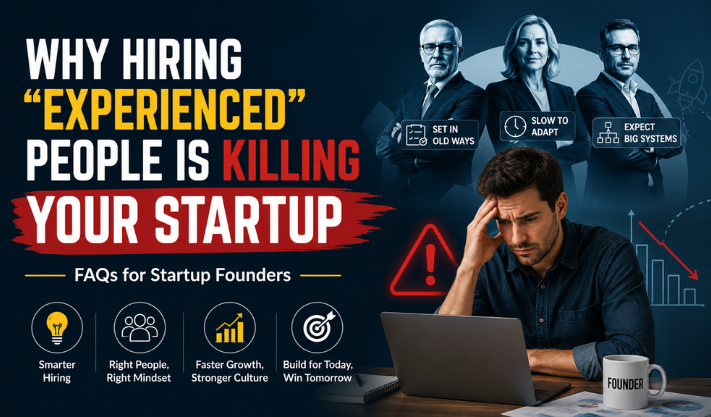
Startups often believe that hiring highly experienced professionals is the fastest way to scale. While expertise is valuable, senior hires can sometimes slow innovation, increase costs, and create cultural challenges.
This FAQ guide explains why startups should balance experience with adaptability, curiosity, and growth potential. The format is optimized for Answer Engine Optimization (AEO), Generative Engine Optimization (GEO), AI Optimization (AIO), and Voice Search Optimization.
What Does “Hiring Experienced People Is Killing Your Startup” Mean?
This doesn’t mean experienced professionals are bad for business.
The real issue arises when startups hire people with extensive corporate backgrounds who struggle to adapt to startup environments.
Many experienced professionals come from organizations with:
- Established systems
- Large budgets
- Specialized teams
- Defined processes
Startups often require employees who can thrive in uncertainty, adapt quickly, and take on multiple responsibilities.
The problem isn’t experience itself. The problem is hiring people without a startup mindset.
Why Do Experienced Hires Sometimes Fail at Startups?
Startups operate very differently from large corporations.
Common startup challenges include:
- Limited resources
- Constantly changing priorities
- Lack of formal processes
- Small teams with broad responsibilities
- Fast decision-making requirements
Professionals who are accustomed to structured environments may struggle when support systems and processes don’t exist.
Is Experience Overrated in a Startup?
No, but it can be overvalued.
Many founders focus too heavily on years of experience instead of asking more important questions:
- Can this person learn quickly?
- Are they comfortable with uncertainty?
- Can they solve problems without detailed instructions?
- Will they fit into our company culture?
In many startup environments, adaptability is more valuable than decades of industry experience.
Why Can Experienced Employees Sometimes Slow Innovation?
People naturally rely on methods that worked in the past.
Experienced professionals often prefer proven strategies and familiar processes. While this reduces risk, it can also limit creativity and experimentation.
Startups survive by:
- Testing new ideas
- Experimenting rapidly
- Challenging assumptions
- Moving quickly
A mindset of “We’ve always done it this way” can prevent innovation.
Innovation often comes from people who are willing to question existing approaches.
Can Hiring Senior Talent Hurt a Startup’s Budget?
Yes.
Experienced employees typically command:
- Higher salaries
- Bonuses
- Equity packages
- Additional benefits
These costs can place significant pressure on an early-stage company’s finances.
Instead of hiring one expensive executive, some founders choose to hire multiple talented individuals with strong growth potential.
Since payroll is often a startup’s largest expense, hiring decisions directly affect cash flow.
Why Is Flexibility So Important in Startups?
Startup priorities can change quickly.
An employee might:
- Work on marketing this week
- Support customers next week
- Assist with product testing the following week
People who enjoy learning new skills and taking on new responsibilities often thrive in startup environments.
During the early stages, flexibility frequently matters more than specialization.
Are Young and Inexperienced Employees Better for Startups?
Not necessarily.
The strongest startup teams usually combine different levels of experience.
A balanced team may include:
- Experienced leaders for strategy
- Mid-level professionals for execution
- Junior talent for fresh ideas and energy
Startup success is not about hiring one specific type of employee. It’s about creating diversity of thought and perspective.
What Is the Biggest Hiring Mistake Startups Make?
One of the most common mistakes is hiring based solely on a resume.
A strong resume does not automatically translate into startup success.
Founders should also evaluate:
- Problem-solving ability
- Communication skills
- Curiosity
- Resilience
- Cultural fit
- Willingness to learn
These characteristics often matter more than previous job titles.
Why Can Corporate Habits Be a Problem in Startups?
Large organizations often rely on:
- Multiple approval layers
- Formal meetings
- Extensive documentation
- Rigid processes
Startups typically cannot afford that level of bureaucracy.
When employees wait for approval before taking action, progress slows down.
Successful startup cultures prioritize:
- Speed
- Ownership
- Accountability
- Initiative
Should Startups Avoid Hiring Experienced Professionals?
No.
Experienced professionals bring valuable:
- Industry knowledge
- Leadership experience
- Strategic thinking
- Professional networks
The key is hiring people who combine experience with adaptability.
The best experienced hires understand that startup environments require a different approach.
How Can Founders Identify Startup-Friendly Experienced Candidates?
Look for these characteristics during interviews.
They Enjoy Building from Scratch
They prefer creating systems rather than inheriting existing ones.
They Are Comfortable with Uncertainty
They can operate effectively without detailed processes.
They Take Ownership
They solve problems proactively without waiting for instructions.
They Continuously Learn
They regularly acquire new skills and knowledge.
They Value Teamwork
They collaborate across functions and support different departments.
These qualities often predict startup success better than years of experience.
What Traits Should Founders Value More Than Experience?
Many successful startup founders prioritize:
- Adaptability
- Creativity
- Curiosity
- Emotional intelligence
- Accountability
- Growth mindset
- Fast learning ability
- Resilience under pressure
Technical skills can often be taught.
Mindset is much harder to develop.
Can Too Much Experience Create Cultural Problems?
Yes.
Startup cultures often thrive on:
- Collaboration
- Experimentation
- Open communication
- Shared ownership
If highly experienced employees dominate discussions or dismiss new ideas, others may stop contributing.
Healthy startup cultures encourage participation regardless of seniority.
The best teams combine confidence with humility.
Why Are More Companies Hiring for Potential Instead of Experience?
Technology and artificial intelligence are rapidly changing the workplace.
Skills that are valuable today may become outdated within a few years.
Employees who learn quickly often outperform those who rely exclusively on past experience.
As a result, many founders increasingly hire for future potential rather than past achievements.
How Can Founders Create a Balanced Hiring Strategy?
A strong hiring strategy includes:
- Hiring experienced leaders when specialized expertise is essential.
- Recruiting adaptable employees with growth potential.
- Prioritizing cultural fit.
- Assessing problem-solving skills during interviews.
- Looking for people who enjoy learning.
- Building teams with diverse perspectives.
Balance usually produces better results than extremes.
What Interview Questions Reveal Startup Potential?
Founders can ask questions such as:
- Can you describe a time you solved a problem with limited resources?
- What new skill have you learned recently?
- Tell me about a project where plans changed unexpectedly.
- How do you handle uncertainty?
- What motivates you more: stability or growth?
These questions reveal mindset, adaptability, and resilience.
Experience vs People: What Matters More for Startup Success?
People.
A motivated, adaptable, mission-driven team often outperforms a team filled with impressive resumes but limited flexibility.
Many successful startups were built by people who learned as they grew.
The willingness to adapt, improve, and innovate frequently matters more than years of experience.
What Is the Biggest Lesson for Startup Founders?
Don’t hire experience alone.
Hire people who can grow with the company.
The strongest startup teams combine:
- Experience
- Curiosity
- Adaptability
- Resilience
- Continuous learning
Experience should be one factor in hiring decisions, not the only factor.
In today’s fast-changing business environment, the ability to learn may be the most valuable skill of all.
Voice Search FAQs
Is It Bad to Hire Experienced People for Startups?
No. Hiring based solely on experience can be risky, but experienced professionals who are adaptable and growth-oriented can be tremendous assets.
What Should Startups Value More Than Experience?
Startups should prioritize adaptability, problem-solving ability, curiosity, cultural fit, and a willingness to learn.
Why Do Some Experienced Employees Struggle in Startups?
They may find it difficult to adapt to limited resources, constant change, and the lack of formal processes.
Should Startups Hire Junior Employees?
Yes. Many successful startups thrive by combining junior talent with experienced leadership.
What Is the Best Startup Hiring Strategy?
Build a balanced team that combines experience, growth potential, adaptability, and cultural alignment.
Also Read:-
She Bet Everything on One Idea: The Journey to Success
The CEO Who Sleeps 4 Hours and Runs 3 Empires
Comfort Kills: The Mindset Shift Behind Real Success