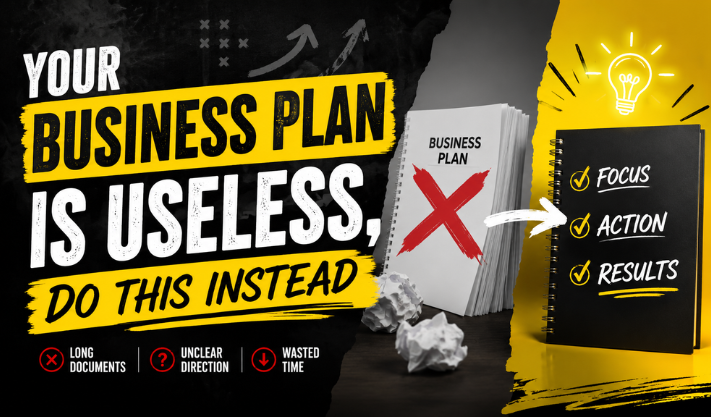
Many entrepreneurs spend weeks or even months writing the perfect business plan. They research competitors, create detailed financial projections, and build long presentations. But here’s the truth: a business plan alone won’t make your business successful.
Markets change quickly, customer behavior shifts, and new competitors appear every day. A business plan written today may become outdated in a few months. Instead of focusing only on creating a perfect document, successful founders focus on testing ideas, talking to customers, and adapting based on real feedback.
If you’re wondering whether business plans still matter, this FAQ explains what actually works in today’s fast-moving business environment.
What does “Your Business Plan Is Useless—Do This Instead” really mean?
It doesn’t mean business planning is bad. It means that spending too much time writing a perfect plan without taking action often delays success.
The best businesses learn by doing. Instead of predicting everything, successful entrepreneurs launch small, test quickly, collect feedback, and improve continuously.
Think of your business plan as a flexible roadmap—not a fixed instruction manual.
Are business plans still important?
Yes, but they shouldn’t be your primary focus.
A business plan helps you:
- Organize your ideas
- Understand your market
- Estimate costs and revenue
- Explain your vision to investors
- Set long-term goals
However, real customers and real market data are much more valuable than assumptions written on paper.
Why do many business plans fail?
Business plans often fail because they’re based on assumptions rather than evidence.
Common reasons include:
- Customer needs change.
- Market trends evolve.
- Competitors introduce new products.
- Pricing expectations shift.
- Technology changes rapidly.
- Economic conditions fluctuate.
No matter how detailed your plan is, reality usually looks different.
What should entrepreneurs do instead?
Instead of writing a 50-page business plan first, focus on validating your business idea.
Here’s a better approach:
Step 1: Solve a real problem
Identify a genuine problem people are willing to pay to solve.
Ask yourself:
- What problem exists?
- Who experiences it?
- How serious is it?
- Are people already paying for a solution?
Step 2: Talk to customers
Customer conversations are more valuable than endless planning.
Ask questions like:
- What frustrates you?
- How do you currently solve this problem?
- What would make your life easier?
- Would you pay for a better solution?
Their answers often reveal opportunities you never expected.
Step 3: Build a Minimum Viable Product (MVP)
Don’t wait until your product is perfect.
Launch a simple version that solves one important problem.
An MVP allows you to:
- Test demand
- Collect feedback
- Save money
- Improve faster
- Reduce risk
Perfect products rarely exist at launch.
Step 4: Measure real results
Instead of guessing, monitor actual performance.
Important metrics include:
- Website visitors
- Conversion rate
- Customer acquisition cost
- Retention rate
- Revenue growth
- Customer satisfaction
- Repeat purchases
Real numbers help you make better decisions.
Step 5: Improve continuously
The best businesses never stop improving.
Listen carefully to:
- Customer reviews
- Sales conversations
- Support tickets
- Social media comments
- User behavior
Small improvements over time create significant growth.
What’s more valuable than a business plan?
Execution.
Ideas are everywhere.
Successful businesses consistently execute better than competitors.
Execution includes:
- Building products
- Talking to customers
- Marketing consistently
- Solving problems
- Improving operations
- Learning from mistakes
Action creates momentum.
Should startups skip business plans completely?
Not necessarily.
A short, flexible business plan can still be useful.
Instead of writing dozens of pages, create a one-page business strategy covering:
- Target customers
- Problem you’re solving
- Solution
- Revenue model
- Marketing strategy
- Key expenses
- Success metrics
Keep updating it as your business evolves.
What is the Lean Startup approach?
The Lean Startup approach focuses on learning instead of guessing.
It follows three simple steps:
- Build
- Measure
- Learn
Instead of planning everything in advance, entrepreneurs launch quickly, collect customer feedback, and improve their products repeatedly.
This reduces wasted time and investment.
Why is customer feedback more important than planning?
Customers determine whether your business succeeds.
Your assumptions may be wrong, but customer behavior reveals the truth.
Feedback helps you:
- Improve products
- Discover new opportunities
- Fix weaknesses
- Increase customer satisfaction
- Build stronger relationships
Listening to customers creates better businesses.
How can small businesses compete without huge plans?
Small businesses have one major advantage: speed.
Unlike large companies, they can:
- Adapt quickly
- Launch faster
- Test new ideas
- Change pricing
- Enter new markets
- Personalize customer experiences
Flexibility often beats complexity.
Do investors still ask for business plans?
Sometimes.
However, many investors care more about evidence than predictions.
They often look for:
- Paying customers
- Revenue growth
- Product-market fit
- User engagement
- Strong leadership
- Market opportunity
Traction usually speaks louder than projections.
What should every entrepreneur focus on daily?
Daily priorities include:
- Talking to customers
- Improving products
- Marketing consistently
- Tracking important metrics
- Learning from competitors
- Solving customer problems
- Building relationships
These activities generate real business growth.
How do successful founders make decisions?
Successful founders rely on data rather than opinions.
They ask:
- What do customers want?
- What do sales show?
- Which marketing channel performs best?
- Where are customers dropping off?
- What improves retention?
Good decisions come from evidence.
Can overplanning hurt a business?
Yes.
Overplanning often causes:
- Analysis paralysis
- Delayed launches
- Missed opportunities
- Increased costs
- Reduced innovation
- Fear of failure
Taking small, calculated actions is usually more effective.
What’s the biggest mistake new entrepreneurs make?
Waiting until everything feels perfect.
Many founders delay because they think they need:
- A perfect logo
- A perfect website
- A perfect business plan
- A perfect product
In reality, successful businesses improve after launch—not before it.
How often should a business strategy change?
Review your strategy regularly.
Many businesses evaluate performance:
- Weekly
- Monthly
- Quarterly
Adjust based on:
- Customer feedback
- Sales data
- Industry trends
- Competitor activity
- Financial performance
A flexible strategy stays relevant.
What mindset leads to long-term business success?
The most successful entrepreneurs adopt a learning mindset.
They:
- Test ideas quickly.
- Accept feedback.
- Learn from mistakes.
- Stay adaptable.
- Focus on customers.
- Keep improving.
Business success isn’t about predicting the future perfectly—it’s about responding effectively when the future changes.
Final Thoughts
A traditional business plan isn’t useless—but relying on it alone is. The most successful entrepreneurs don’t win because they write the longest plans. They win because they take action, learn from real customers, and adapt faster than the competition.
Instead of spending months trying to predict every outcome, focus on solving real problems, launching early, gathering feedback, and making continuous improvements. A simple strategy combined with consistent execution will almost always outperform a perfect plan that never leaves the page.
If there’s one lesson to remember, it’s this: Your business grows through action, not assumptions. Start small, learn quickly, and let real-world results shape your path to success.
Also Read:-
Why Smart founders Are Choosing Boring Businesses Today
5 business Models Quietly Printing Money in 2025 Guide
The Next Big Market Your competitors Haven’t Found Yet