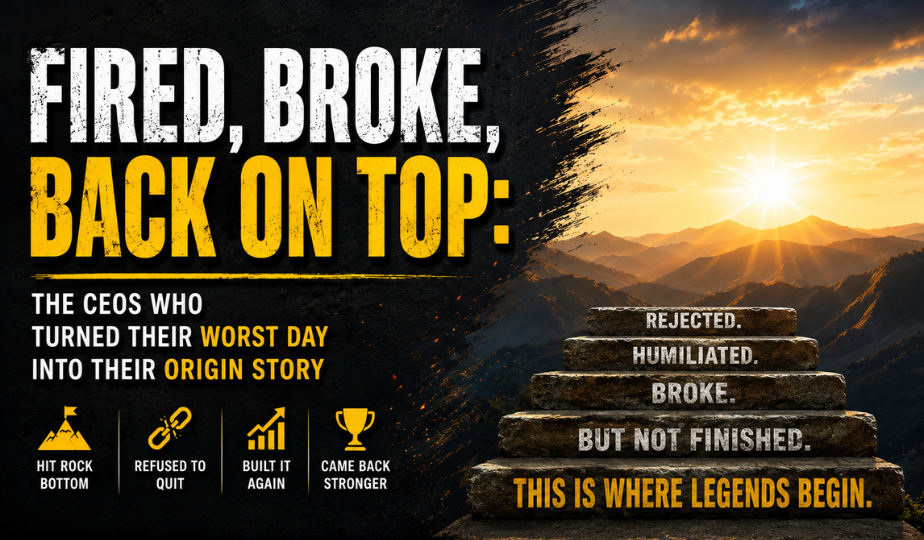
Success stories often focus on billion-dollar companies, groundbreaking innovations, and global recognition. But behind many of the world’s most admired CEOs is a chapter filled with failure, financial hardship, public criticism, or even unemployment. For many business leaders, their worst day became the foundation of their greatest success.
Table of Contents
ToggleWhat does “Fired, Broke, Back on Top” mean?
It refers to CEOs and entrepreneurs who experienced major setbacks—such as losing their jobs, running out of money, or facing business failure—before rebuilding their careers and achieving remarkable success.
These leaders demonstrate that failure isn’t the end of the journey. Instead, it often becomes the starting point for stronger leadership, smarter decisions, and long-term growth.
Why do many successful CEOs experience failure first?
Failure teaches lessons that success often cannot.
Many CEOs discover:
- Better leadership skills
- Financial discipline
- Smarter decision-making
- Greater resilience
- Stronger emotional intelligence
Challenges force entrepreneurs to rethink strategies, improve products, and understand customers more deeply.
Which famous CEOs turned failure into success?
Here are some of the most inspiring examples.
Steve Jobs
Steve Jobs was famously removed from Apple in 1985 after internal disagreements with the company’s board.
Instead of giving up, he founded NeXT and acquired Pixar, helping transform computer animation.
Years later, Apple purchased NeXT, bringing Jobs back. Under his leadership, Apple launched products like the iMac, iPod, iPhone, and iPad, becoming one of the world’s most valuable companies.
Lesson: Sometimes rejection prepares you for your greatest comeback.
Howard Schultz
Before transforming Starbucks into a global coffee brand, Howard Schultz faced repeated investor rejections.
More than 200 investors declined his business vision.
Rather than quitting, Schultz continued refining his idea until he secured funding. Today, Starbucks operates thousands of stores worldwide.
Lesson: Persistence often matters more than immediate approval.
Elon Musk
During the late 2000s, Elon Musk faced one of the toughest periods of his career.
Tesla struggled financially, SpaceX experienced multiple rocket failures, and Musk invested nearly all of his personal fortune to keep both companies alive.
Eventually, SpaceX achieved successful launches, and Tesla became a leader in electric vehicles.
Lesson: Calculated risk and persistence can overcome extraordinary obstacles.
Jan Koum
WhatsApp co-founder Jan Koum grew up in financial hardship after immigrating to the United States.
He was once rejected for a job at Facebook.
Years later, Facebook acquired WhatsApp for approximately $19 billion.
Lesson: Today’s rejection can become tomorrow’s opportunity.
Arianna Huffington
Before launching The Huffington Post, Arianna Huffington had her second book rejected by dozens of publishers.
Instead of abandoning her writing career, she continued creating content and eventually built one of the internet’s most influential news platforms.
Lesson: Repeated rejection doesn’t define future success.
What can entrepreneurs learn from CEOs who lost everything?
Several important lessons emerge from these stories.
Failure builds resilience
Every setback teaches valuable experience that improves future decisions.
Adaptability matters
Successful CEOs change strategies when markets evolve instead of resisting change.
Long-term thinking wins
Many business leaders focus on years of growth rather than short-term setbacks.
Relationships are valuable
Strong mentors, teams, and investors often play a major role during difficult periods.
Keep learning
The best CEOs never stop improving their leadership, communication, and business knowledge.
Can getting fired actually help a CEO?
Yes.
Being fired can create space for innovation, reflection, and personal growth.
Many entrepreneurs say losing a job forced them to:
- Start their own business
- Learn new skills
- Explore different industries
- Build stronger companies
- Develop better leadership habits
Although painful, career setbacks sometimes become turning points.
How do CEOs recover after financial failure?
Recovery usually happens through consistent action rather than one big breakthrough.
Successful CEOs often:
- Reduce unnecessary expenses
- Focus on solving real customer problems
- Build experienced teams
- Learn from previous mistakes
- Improve cash flow management
- Stay patient during slow growth periods
Business recovery typically takes time, persistence, and disciplined execution.
What mindset helps entrepreneurs overcome failure?
Growth mindset is one of the biggest factors behind successful comebacks.
This means believing that skills, businesses, and careers can improve through learning and effort.
Instead of asking:
“Why did this happen to me?”
Successful entrepreneurs ask:
“What can I learn from this?”
That simple shift creates better decisions and greater resilience.
Is failure common among startup founders?
Yes.
Most startups face significant obstacles before achieving sustainable success.
Common startup challenges include:
- Running out of funding
- Product-market fit issues
- Hiring mistakes
- Slow customer growth
- Marketing failures
- Economic downturns
Many founders experience multiple failures before building a successful company.
Why do investors respect founders who have failed before?
Many experienced investors understand that failure provides practical business education.
Founders who have previously failed often possess:
- Better risk assessment
- Stronger financial awareness
- More realistic expectations
- Improved leadership skills
- Greater resilience under pressure
While failure alone doesn’t guarantee success, learning from it can make founders stronger business leaders.
How can entrepreneurs bounce back after losing a business?
Recovery begins with honest evaluation.
Practical steps include:
- Analyze what went wrong.
- Accept responsibility where appropriate.
- Learn new skills.
- Build a stronger financial plan.
- Seek mentorship.
- Start small if necessary.
- Focus on solving meaningful customer problems.
Every successful comeback begins with taking the next step.
What habits do comeback CEOs share?
Many resilient business leaders consistently practice similar habits.
These include:
- Reading regularly
- Making data-driven decisions
- Exercising discipline
- Building strong teams
- Staying curious
- Embracing change
- Learning from criticism
- Remaining customer-focused
These habits compound over time and strengthen leadership.
Why are comeback stories important for future entrepreneurs?
Stories of recovery remind aspiring founders that setbacks are normal.
Business success is rarely a straight line.
Most entrepreneurs experience periods of uncertainty, financial pressure, rejection, or failure before reaching major milestones.
Understanding this reality helps reduce fear and encourages long-term thinking.
Can failure become a competitive advantage?
Absolutely.
Entrepreneurs who recover from failure often develop unique strengths that competitors may lack.
These include:
- Better crisis management
- Smarter budgeting
- Greater emotional resilience
- Stronger leadership under pressure
- Faster problem-solving
Experience gained during difficult times can become one of a leader’s greatest assets.
Final Thoughts
The stories behind many of today’s most successful CEOs prove that failure is rarely the final chapter. Being fired, facing bankruptcy, losing investors, or enduring public setbacks can become powerful turning points when met with resilience, adaptability, and continuous learning.
Whether it’s Steve Jobs returning to Apple, Howard Schultz overcoming countless rejections, Elon Musk surviving financial crises, Jan Koum turning rejection into a multi-billion-dollar opportunity, or Arianna Huffington persevering through repeated setbacks, each journey reinforces the same message: success is built through persistence, not perfection.
For entrepreneurs, founders, and aspiring business leaders, the takeaway is simple—your worst business day does not define your future. The lessons you learn, the resilience you build, and the actions you take afterward often become the true origin story of lasting success.