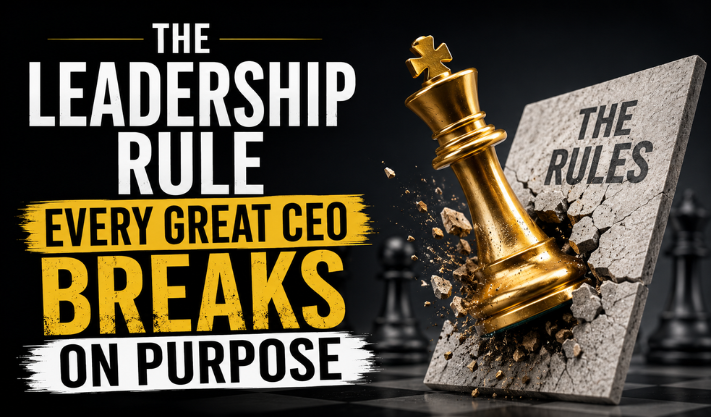
Leadership advice is everywhere. Business books, executive coaches, and management experts often repeat the same rules: stay consistent, avoid risks, maintain strict control, and always follow established processes.
Yet when you study some of the world’s most successful CEOs, a surprising pattern emerges. Many of them intentionally break traditional leadership rules. They do so strategically, not recklessly. They understand that exceptional results often require unconventional thinking.
So, what is the leadership rule every great CEO breaks on purpose?
The answer is simple: Great CEOs know when to ignore conventional wisdom and make decisions based on what the situation truly demands.
This article answers common questions about why successful leaders sometimes break the rules and how this approach helps organizations grow.
What leadership rule do great CEOs intentionally break?
Great CEOs often break the rule that leaders must always follow established best practices.
While best practices can provide guidance, they are not always the best solution for every challenge. Successful CEOs recognize that every business situation is unique. They adapt their decisions to fit changing circumstances rather than blindly following traditional methods.
This flexibility allows them to innovate, move faster, and create opportunities that competitors often miss.
Why don’t successful CEOs always follow conventional leadership advice?
Conventional leadership advice is usually based on past experiences and proven systems. While useful, these recommendations are not universal solutions.
Markets change. Customer expectations evolve. Technology advances rapidly.
A CEO who follows outdated rules without questioning them may struggle to keep pace with change.
Great leaders constantly evaluate whether existing approaches still serve their organizations. When they don’t, they are willing to challenge assumptions and explore new strategies.
Is breaking leadership rules risky?
Yes, breaking leadership rules can involve risk.
However, successful CEOs don’t take random risks. They make calculated decisions based on data, experience, market conditions, and long-term goals.
The difference between reckless leadership and strategic leadership is intention.
Effective CEOs understand the potential consequences of their choices and prepare for multiple outcomes before acting.
How does rule-breaking encourage innovation?
Innovation often happens when people challenge accepted ways of thinking.
If leaders insist that employees always follow existing systems, new ideas may never emerge.
Many groundbreaking companies were built because leaders questioned traditional business models and explored different possibilities.
When CEOs encourage thoughtful experimentation, teams become more creative, adaptable, and willing to solve problems in new ways.
This mindset can lead to better products, improved customer experiences, and stronger competitive advantages.
Do great CEOs ignore all leadership rules?
No. Successful CEOs do not ignore every rule.
In fact, most highly effective leaders follow core principles such as integrity, accountability, transparency, and respect.
The rules they tend to break are operational or conventional rules that may no longer support growth.
They know the difference between values that should never be compromised and procedures that may need to evolve.
Why is adaptability considered a leadership superpower?
Adaptability allows leaders to respond effectively when circumstances change.
Business environments rarely remain stable for long. Economic conditions shift, industries transform, and customer preferences evolve.
A rigid leader may struggle during periods of uncertainty.
An adaptable leader can assess new information, adjust strategies, and guide teams through challenges without losing momentum.
This ability often separates average leaders from exceptional ones.
Can breaking leadership rules improve decision-making?
Yes, it often can.
Traditional leadership models sometimes encourage lengthy approval processes and excessive analysis.
While careful consideration is important, delays can cause businesses to miss opportunities.
Many successful CEOs prioritize speed when appropriate. They gather sufficient information, make informed decisions, and adjust as new information becomes available.
This approach helps organizations remain agile in competitive markets.
What examples show CEOs breaking traditional leadership rules?
Throughout business history, many influential CEOs have challenged conventional thinking.
Some leaders launched products that experts predicted would fail.
Others entered markets considered too competitive or too risky.
Many successful entrepreneurs rejected traditional industry assumptions and created entirely new business categories.
Their success often came from seeing possibilities where others saw obstacles.
The common theme is not rule-breaking for its own sake. It is the willingness to question assumptions and pursue opportunities others overlook.
How can leaders know when a rule should be broken?
Leaders should ask several important questions:
- Does this rule still serve its original purpose?
- Is the rule helping or slowing progress?
- What evidence supports keeping or changing it?
- What are the risks and benefits of a different approach?
- How will the decision affect employees, customers, and stakeholders?
Thoughtful analysis helps leaders determine whether challenging a rule is likely to create positive results.
What role does courage play in leadership?
Courage is essential for effective leadership.
Breaking from accepted norms often attracts criticism. People are naturally comfortable with familiar systems and may resist change.
Great CEOs understand that leadership sometimes requires making unpopular decisions.
They focus on long-term outcomes rather than short-term approval.
This willingness to act despite uncertainty often drives meaningful progress.
Can small business owners apply this leadership lesson?
Absolutely.
The principle applies to businesses of every size.
Small business owners frequently face unique challenges that require creative solutions. Following standard industry practices may not always produce the desired results.
By evaluating situations independently and remaining open to alternative approaches, entrepreneurs can discover new growth opportunities and competitive advantages.
The key is balancing innovation with sound judgment.
What mistakes should leaders avoid when breaking rules?
Leaders should avoid:
- Ignoring data and evidence
- Acting impulsively
- Breaking rules without a clear purpose
- Overlooking potential consequences
- Failing to communicate changes effectively
Successful CEOs challenge rules strategically, not emotionally.
Their decisions are typically supported by careful planning and a clear understanding of desired outcomes.
How does this leadership approach affect company culture?
When leaders demonstrate thoughtful flexibility, employees often feel empowered to think creatively.
A culture that encourages questioning assumptions can improve problem-solving, innovation, and engagement.
Employees become more comfortable sharing ideas and proposing improvements.
As a result, organizations often become more resilient and better equipped to navigate change.
What is the biggest lesson from great CEOs?
The most important lesson is that leadership is not about blindly following rules.
It is about understanding which principles should remain constant and which practices should evolve.
Great CEOs respect proven methods, but they are not controlled by them.
They recognize that extraordinary results often require unconventional thinking.
By staying adaptable, questioning assumptions, and making intentional decisions, leaders position themselves and their organizations for long-term success.
Final Thoughts
The leadership rule every great CEO breaks on purpose is the belief that all established rules must always be followed.
Exceptional leaders understand that success requires judgment, flexibility, and the courage to challenge outdated thinking.
They know that while values should remain steady, strategies must evolve with changing circumstances.
Whether you lead a global corporation, a growing startup, or a small team, the ability to think independently and adapt intelligently can become one of your most valuable leadership strengths.
The best leaders don’t break rules because they enjoy disruption. They break them because progress often depends on it.
Also Read:-
Why Top CEOs Make Critical Decisions in Under 60 Seconds
No MBA, No Connections: How to Succeed on Your Own
The New Unicorn Race: AI Startups Transforming healthcare