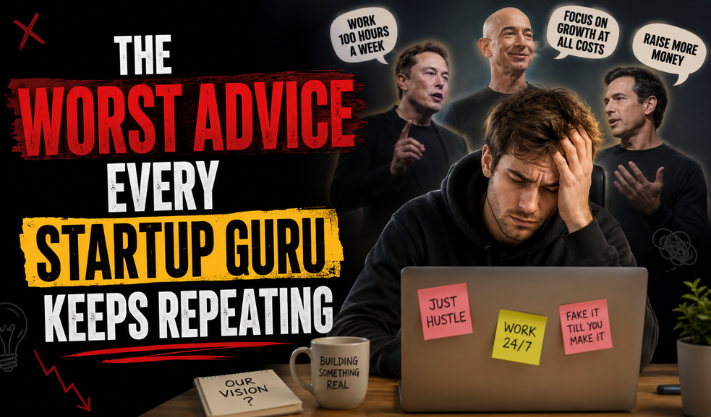
Starting a business has never been easier—or more confusing. Entrepreneurs today have access to countless podcasts, books, social media posts, and startup influencers offering advice on how to build a successful company. While some guidance is valuable, much of the advice repeated by startup gurus is outdated, oversimplified, or simply wrong.
The reality is that building a successful startup requires context, strategy, and critical thinking. What worked for one founder may not work for another. In this FAQ guide, we’ll examine some of the worst startup advice that continues to circulate and explain what entrepreneurs should do instead.
What Is the Most Common Bad Startup Advice?
One of the most common pieces of bad startup advice is:
“Just Follow Your Passion”
While passion is important, it is not enough to build a successful business. Many founders are passionate about ideas that have little market demand. A startup succeeds when it solves a real problem that customers are willing to pay to fix.
Instead of only following your passion, focus on:
- Identifying market opportunities
- Understanding customer pain points
- Creating valuable solutions
- Building sustainable revenue streams
Passion helps you stay motivated, but customer demand creates business success.
Is “Build It and They Will Come” Good Advice?
No. This advice has caused countless startups to fail.
Many entrepreneurs spend months or years building products before talking to customers. They assume people will automatically buy once the product launches.
In reality, successful startups validate demand early.
Before building:
- Interview potential customers
- Test assumptions
- Create prototypes
- Gather feedback
- Confirm willingness to pay
Customer validation should happen before major development begins.
Should Startups Focus Only on Growth?
Not necessarily.
Many startup gurus glorify growth at all costs. They encourage founders to prioritize user acquisition over profitability, operations, or sustainability.
Rapid growth can be beneficial, but growth without a business model creates problems.
Healthy startups balance:
- Revenue growth
- Customer satisfaction
- Product quality
- Cash flow management
- Long-term sustainability
Growth is important, but sustainable growth is even better.
Is Raising Venture Capital Always the Goal?
No.
One of the biggest misconceptions in entrepreneurship is that every startup should raise venture capital.
Many profitable businesses never take outside funding.
Venture capital makes sense when:
- Markets are large
- Growth opportunities are significant
- Speed matters
- Competitive pressure exists
For many founders, bootstrapping offers greater control, ownership, and flexibility.
Funding is a tool, not a measure of success.
Is “Fake It Until You Make It” Good Business Advice?
Not really.
Confidence is valuable, but deception can damage trust.
Some founders interpret this advice as permission to exaggerate results, inflate metrics, or overpromise capabilities.
Successful businesses are built on credibility.
Instead:
- Be transparent
- Communicate honestly
- Set realistic expectations
- Deliver consistent results
Trust takes years to build and seconds to lose.
Should Entrepreneurs Work 24/7?
No.
Startup culture often celebrates extreme hustle and burnout. Many gurus suggest working every waking hour, sacrificing sleep, relationships, and health.
Research consistently shows that exhaustion reduces productivity, creativity, and decision-making quality.
Effective founders focus on:
- Energy management
- Prioritization
- Delegation
- Strategic thinking
- Sustainable work habits
Long-term success requires endurance, not constant exhaustion.
Is Failure Always a Good Thing?
Failure can be valuable, but it should not be romanticized.
Many startup influencers repeat phrases like:
- “Fail fast.”
- “Fail often.”
- “Failure is success.”
The real lesson is not failure itself. The lesson is learning.
Smart founders aim to:
- Test ideas cheaply
- Minimize unnecessary mistakes
- Learn quickly
- Adapt effectively
The goal is not to fail. The goal is to improve.
Should Founders Ignore Competitors?
No.
Some gurus claim entrepreneurs should never pay attention to competitors. While obsessing over competitors can be distracting, ignoring them completely is risky.
Competitor analysis helps founders understand:
- Market trends
- Customer expectations
- Pricing strategies
- Product gaps
- Emerging threats
The best approach is awareness without obsession.
Focus on customers first, but understand your competitive landscape.
Is Being First to Market the Key to Success?
Not always.
Many people believe the first company in a market automatically wins.
History shows otherwise.
- Google was not the first search engine.
- Facebook was not the first social network.
- Netflix was not the first video rental service.
Execution often matters more than timing.
The winners usually:
- Build better products
- Create superior customer experiences
- Adapt quickly
- Execute consistently
Being first helps, but being better matters more.
Should Startups Prioritize Features Over Customers?
No.
Founders often become obsessed with adding new features. However, customers rarely buy products because they have the most features.
Customers buy solutions.
Before building new features, ask:
- Does this solve a customer problem?
- Will users actually use it?
- Does it improve retention?
- Does it create measurable value?
Customer needs should guide product development.
Is “Think Big” Always Good Advice?
Thinking big can inspire innovation, but unrealistic ambition can also create problems.
Some founders attempt to dominate global markets before proving local demand.
Successful startups often begin with focused execution.
Start by:
- Solving one problem
- Serving one audience
- Building one strong product
Scale after achieving product-market fit.
Big visions succeed when supported by practical execution.
What Advice Should Entrepreneurs Follow Instead?
Rather than following startup clichés, entrepreneurs should focus on proven principles.
Listen to Customers
Customer feedback is often more valuable than expert opinions.
Solve Real Problems
Businesses succeed when they eliminate pain points and create value.
Focus on Product-Market Fit
A great product for the wrong market rarely succeeds.
Build Sustainable Systems
Processes, teams, and operations matter as much as innovation.
Learn Continuously
Markets evolve, technologies change, and customer expectations shift. Adaptability is one of the most important entrepreneurial skills.
Why Does Bad Startup Advice Spread So Easily?
Bad advice spreads because it is simple, memorable, and easy to share.
Complex truths rarely go viral.
Statements like:
- “Follow your passion.”
- “Hustle harder.”
- “Think bigger.”
- “Raise funding.”
Sound inspiring but often ignore real-world complexity.
Successful entrepreneurship requires nuance, experimentation, and context. No single rule applies to every business.
What Is the Best Startup Advice Overall?
The best startup advice is surprisingly simple.
Talk to Customers, Solve Meaningful Problems, and Create Value Consistently
Most successful companies follow this principle.
Markets reward businesses that improve people’s lives, save time, reduce costs, or solve important challenges.
Everything else—funding, growth, branding, and scaling—becomes easier when customers genuinely value what you offer.
Final Thoughts
Startup gurus often share advice that sounds inspiring but lacks context. While some recommendations contain useful insights, blindly following popular startup wisdom can lead founders in the wrong direction.
The most successful entrepreneurs focus less on motivational slogans and more on understanding customers, validating ideas, building sustainable businesses, and executing effectively.
Instead of chasing startup myths, focus on solving real problems for real people. That approach has created successful companies for decades—and it remains the most reliable path to entrepreneurial success today.
Also Read:-
Stop Building Products. Start Building Monopolies
Why Hiring Experienced People Hurts Startup Growth
She Bet Everything on One Idea: The Journey to Success